

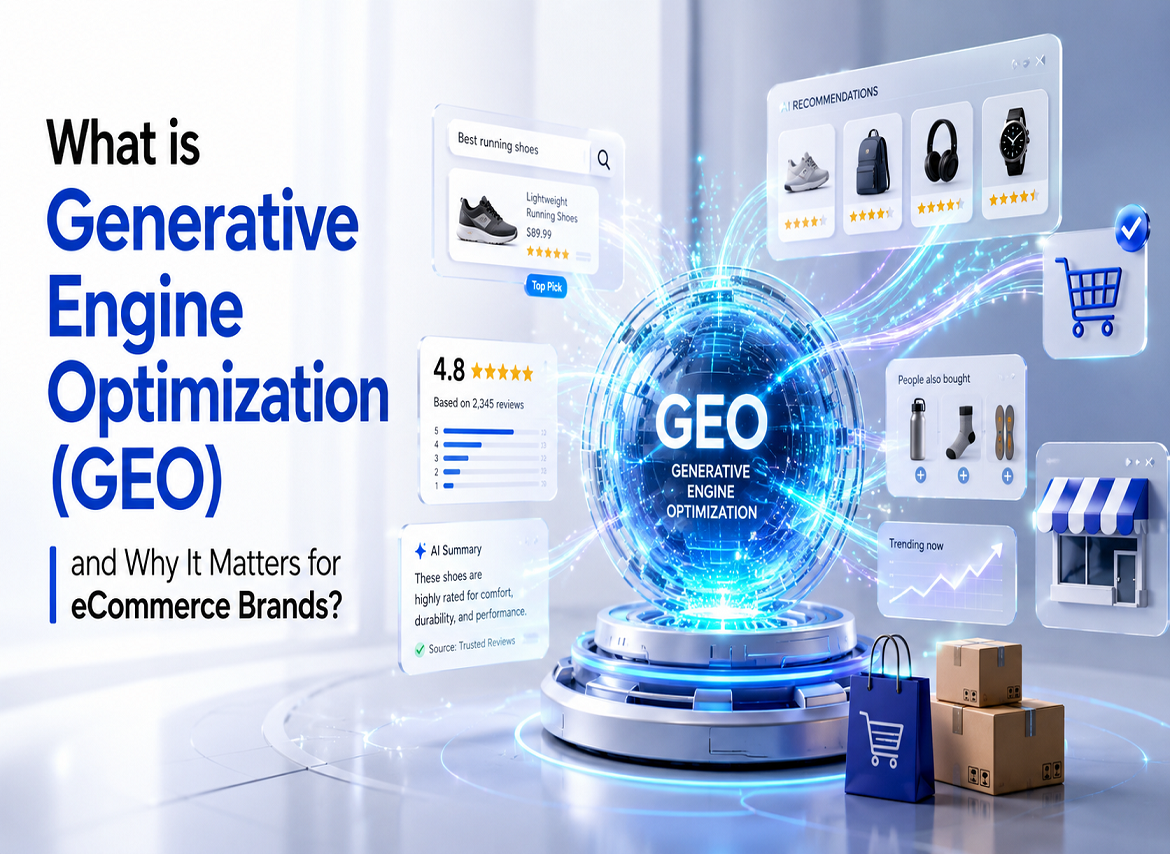

Today, however, the search doesn’t happen on conventional results pages. The consumers today are reaching out to the likes of Google AI Overviews, ChatGPT, Gemini, Perplexity, Bing Copilot, and others to ask their questions.
The answers generated by these services go beyond merely linking to sources. They include summaries, analysis, comparisons, and, most importantly, guidance.
And this is where Generative Engine Optimization comes into play.
When it comes to eCommerce brands, the evolution is evident. The consumer isn’t looking up for generic queries such as “best running shoes” or “cotton sarees online.” They now ask specific queries like “which running shoes are best for beginners?” or “which saree fabric is ideal for summer weddings?” In the absence of content suitable for AI generation, your brand can be overlooked at an extremely crucial phase in its buying process.
Here at Cresconnect, we help eCommerce brands optimize their search strategy for both SEO and AI discovery.
What is GEO?
GEO stands for Generative Engine Optimization. It is the process of optimizing your website content so generative AI systems can understand, summarize, cite, and recommend your brand, products, or services in AI-generated responses.
In simple terms, GEO helps your content become more useful for generative search engines.
Traditional search engines usually return a list of pages. Generative engines create direct answers by pulling information from multiple sources. These answers may include product recommendations, summaries, comparisons, buying advice, and source links.
For eCommerce brands, GEO is about making product pages, category pages, blogs, FAQs, and buying guides easier for AI systems to interpret. Google’s own guidance explains how AI features like AI Overviews and AI Mode work from a site owner’s perspective, which makes AI search visibility an important part of modern SEO planning.
Generative SEO vs Traditional SEO
Generative SEO does not take the place of classic SEO. Rather, generative SEO represents the evolution of SEO in the era of AI-enabled search.
SEO makes sure that your website ranks well on search engines. Generative engine optimization ensures that the content you have created is helpful enough to make it into AI-driven responses and recommendations.
| Factor | Traditional SEO | Generative Engine Optimization |
| Main Goal | Rank pages in search results | Get referenced in AI-generated answers |
| Search Format | Links and snippets | Summaries, comparisons, answers |
| Content Focus | Keywords, backlinks, page quality | Entities, intent, clarity, trust |
| Best For | Organic traffic | AI search visibility and brand mentions |
| Key Assets | Blogs, landing pages, backlinks | Answer blocks, structured data, FAQs, product details |
A strong eCommerce strategy needs both. SEO builds the foundation. GEO prepares your brand for the way users now search, compare, and make buying decisions through AI tools.
Why GEO SEO Matters in 2026
GEO SEO matters because search behavior is becoming more conversational and AI-led. Users are asking longer, more specific questions and expecting useful answers quickly.
Google describes AI Overviews as AI-generated snapshots that provide key information with links to explore more on the web. This means eCommerce content must do more than target keywords. It must answer real questions clearly, explain products properly, and build trust.
For example, a skincare brand should not only optimize for “vitamin C serum.” It should also answer questions like:
- What does vitamin C serum do?
- Can vitamin C serum be used daily?
- Is vitamin C good for oily skin?
- Should vitamin C be used in the morning or night?
- Which vitamin C serum is best for beginners?
These questions help AI systems understand the relationship between customer intent, product benefits, and your brand’s expertise.
Why eCommerce Brands Need Generative Engine Optimization
eCommerce buying processes are becoming increasingly research-oriented. Buyers will be comparing features, prices, reviews, ingredients, materials, shipping schedules, return policies, and compatibility of products.
This is where Generative Engine Optimization ensures that your brand gets in front of these high-intent searchers.
To illustrate, for instance:
- A fashion brand will show up in “best fabric saree for summer”
- A skincare brand will show up in “best skincare routine for acne-prone skin”
- An electronics brand will show up in “wireless earbuds versus neckband”
- A home decor brand will show up in “best curtains for small spaces”
- A Shopify app brand will show up in “best review app for eCommerce store”
These are no random searches; they are intent-packed searches. When your brand gives the best possible response, you establish credibility even before your audience lands on your web page.
For brands seeking to gain visibility organically, GEO should go hand-in-hand with eCommerce SEO strategies.
How GEO Optimization Helps eCommerce Brands
GEO optimization helps online brands improve visibility across AI search and traditional organic search. It makes your website easier to understand for both search engines and generative AI platforms.
1. Better Product Discovery
Customers often search by need, problem, budget, or occasion. GEO helps your content appear for these detailed queries.
For example, instead of only targeting “linen saree”, a fashion brand can also answer:
Is linen saree good for office wear?
This type of content connects education with product discovery.
2. Stronger Category Pages
Category pages should not only show products. They should explain what the category is, who it is for, how to choose the right product, and what common questions buyers ask.
A strong category page can include:
- Short buying guide
- Product filters
- FAQs
- Comparison table
- Internal links
- Material or feature explanations
- Trust signals
3. Improved Product Page Context
Thin product descriptions are not enough for generative search. Product pages should include details like material, size, usage, benefits, reviews, FAQs, availability, and care instructions.
Google explains that structured data can improve the accuracy of how Google understands eCommerce content.For product pages, Google also says that using both product structured data and Merchant Center feeds can help Google correctly understand and verify product data.
4. More Useful FAQ Content
FAQs are powerful because they match how people naturally search. Instead of generic FAQs, brands should answer real customer concerns such as sizing, ingredients, shipping, returns, product care, and suitability.
Schema.org defines FAQ Page as a page that presents one or more frequently asked questions, which makes it relevant for clear question-answer content.
5. Better Trust and Authority
Generative AI technologies require dependable sources. The quality of content is enhanced when it involves explanations, expertise, consumer opinions, current facts, and transparency regarding policies.
For eCommerce businesses, trustworthiness does not consist of merely saying things but rather consists of making information about products, policies, reviews, and consumer benefits clear to consumers.
Best Practices for Generative SEO
To make generative SEO work for your eCommerce brand, focus on clarity, structure, and credibility.
1. Answer the Question Early
Begin paragraphs with an answer first, then follow up with an explanation.
Example:
Cotton sarees are ideal for summer as they are light and breathable.
This technique makes the text more comprehensible to users and AI alike.
2. Add Entity-Rich Content
Entities can be any individuals, items, brands, categories, materials, ingredients, locations, features, or concepts that aid in understanding context for search systems.
For eCommerce, examples of entities can be:
- Type of product
- Brand
- Material
- Ingredients
- Application
- Occasion
- Price point
- Product category
- User need
- Location
3. Use Structured Data
The use of structured data assists search engines in interpreting page content. According to Google, “structured data that can be found online enables us to better understand page content and learn more about things like people, organizations, creative works, intangible concepts, and places that appear in markup.”
Some examples of important schemas for eCommerce websites include:
- Product schema
- Review schema
- FAQ schema
- Breadcrumb schema
- Organization schema
- Article schema
The definition of Product on Schema.org is any item provided for sale or service, which makes it very pertinent to eCommerce websites.
4. Build Topic Clusters
Do not publish disconnected blogs. Create clusters around important buying topics.
For example, a skincare brand can create a cluster around “oily skin”:
- Best skincare routine for oily skin
- Best serum for oily skin
- Ingredients to avoid for oily skin
- Sunscreen for oily skin
- Moisturizer for oily skin
- Oily skin product FAQs
This builds topical authority and gives generative engines more context about your expertise.
5. Keep Content Updated
Outdated content weakens trust. Update product availability, pricing, specifications, FAQs, recommendations, and buying guides regularly.
A page that was useful last year may not be accurate today if product details, customer expectations, or search behavior have changed.
How to Implement GEO for an eCommerce Website
Here is a practical step-by-step approach to implementing Generative Engine Optimization.
Step 1: Identify Customer Questions
Collect questions from:
- Google Search Console
- Customer support chats
- WhatsApp inquiries
- Product reviews
- Sales calls
- Marketplace FAQs
- On-site search data
These sources show what buyers actually want to know before they purchase.
Step 2: Map Questions to Page Types
Place each question on the right page.
| Question Type | Best Page Type |
| Product-specific questions | Product pages |
| Buying-guide questions | Category pages |
| Educational questions | Blogs |
| Brand trust questions | About, FAQ, policy pages |
| Comparison questions | Blog or collection pages |
This keeps your website organized and helps users find the right information faster.
Step 3: Add Direct Answer Blocks
Use short answer blocks of 40–60 words under important headings. These blocks should clearly answer the question before going into details.
For example:
A cotton kurta is a good choice for daily wear because it is breathable, lightweight, and easy to style for work, college, or casual outings.
This format is useful for both human readers and AI-generated answer systems.
Step 4: Strengthen Product Pages
Add product descriptions, features, applications, reviews, FAQs, product availability, shipping information, returns, comparisons, etc.
According to the Google Merchant Center’s product data specification, properly structured and accurate product data enables Google to match products to queries and avoid any problems with displaying the products.
Step 5: Improve Internal Linking
Connect your blog posts to your categories page, categories page to your products pages, and product page to your relevant guides. This will help both the user and the search engines to understand the consumer journey.
Example:
Your blog about summer sarees needs links to your cotton and linen sarees categories.
Product pages need links to size and care guides.
Your skincare routine blog must have links to some product categories.
Step 6: Add Schema Markup
Use structured data for products, reviews, FAQs, articles, breadcrumbs, and organization details.
Schema does not guarantee rankings or AI visibility, but it helps search systems understand your content more accurately.
Step 7: Build Trust Signals
Add author information, expert review, customer reviews, updated dates, transparent policies, and real brand experience.
For eCommerce, trust signals can include:
- Verified reviews
- Clear return policy
- Shipping details
- Product usage guidance
- Real product photography
- Expert buying advice
- Updated product information
Step 8: Monitor Search Performance
Monitor changes in impressions, clicks, rank, long-tail searches, featured snippet performance, artificial intelligence SEO performance, and assisted conversions.
The GEO approach is not something to just undertake once and forget about. It needs to be incorporated into your SEO and conversion strategies.
GEO Mistakes eCommerce Brands Should Avoid
Generative Engine Optimization has now become an area of interest for many eCommerce brands, yet they are treating it just like SEO, which does not make sense anymore. Generative engine optimization requires a different kind of thinking. It goes beyond adding more keywords or writing more blogs. It is about producing structured and reliable information.
1. Writing Only for Keywords
The biggest error is creating content on just keywords without comprehending the question asked by customers.
For instance, targeting a keyword such as “best cotton saree” is relevant, but a GEO-focused page will also need to ask questions such as:
- Is a cotton saree suitable for summers?
- What is the best cotton saree for everyday use?
- How can I wear a cotton saree to the office?
Generative engines require understanding, context, and answers. In case the content revolves only around keywords without addressing the problem of the user, the results may be poor.
2. Publishing Generic AI-Written Content
AI-generated content is not necessarily an issue per se, but generic content is. Most companies create blogs that appear to be professional but lack genuine knowledge about the products, branding, customer experience, or practical examples.
Content on eCommerce platforms must contain information that addresses specific use cases, materials, sizing tips, care guidelines, customer issues, or comparison factors.
The reason behind this is that the content will be considered more credible and practical, even for a generative search engine.
3. Not Answering Questions Directly
GEO does well when the content you write provides clear answers. Many blogs take a while to get to the point, thus making it difficult for AI tools to pick out any valuable data.
What needs to be done is to provide an answer right away, after which one can elaborate on it.
Instead of spending time building up to the question “What is GEO?”, it’s much better to answer it from the very beginning.
4. Ignoring Structured Data
Structured data makes it easier for search engines to understand your content. For eCommerce sites, not using schema markup represents a huge loss.
Schema types for products, reviews, FAQs, breadcrumbs, and organizations can all help search engines understand your content regarding those elements.
However, although using schema markup does not ensure visibility, it helps create a more solid technical base for GEO optimization.
5. Keeping Product Pages Too Thin
Most websites tend to only provide basic information such as product description, price, image, and an add-to-cart button. This is not sufficient considering the current search tendencies.
An ideal product page must answer buyers’ queries even before they can ask them. The information provided includes benefits, features, materials used, size, application, maintenance, delivery, refund, reviews, FAQs, and how the product compares to others.
The more informative your product page is, the easier it will be for search algorithms and AI programs to understand it.
6. Creating Weak FAQ Sections
FAQs can be helpful to GEO SEO, but only if they are related to actual customer inquiries. Too often, many brands include generic FAQs that ask things like “Why choose us?” or “Is this product good?”, yet don’t give an appropriate response.
Your best FAQs will be those that directly address buyer inquiries such as:
- Is this product beginner friendly?
- What size should I order?
- How do I care for this product?
- Is this material good for the summer?
- When can I expect my delivery?
This makes your content more relevant not only to your customers, but generative engines too.
7. Not Building Topical Authority
Publishing one blog on a topic is not enough. Generative engines need to understand that your brand has depth around a subject.
For example, if you sell skincare products, you should not only write one blog on oily skin. You can build a complete content cluster around oily skin routines, ingredients, product comparisons, beginner guides, FAQs, and common mistakes.
This helps establish topical authority and gives AI systems more context about your expertise.
8. Forgetting Internal Links
An internal link makes it easier for users and search engines to see how your information is linked.
For an eCommerce brand, blogs must link to category pages, category pages must link to product pages, and product pages must link to guides or FAQs.
The internal links make the shopping process easy for customers and help search engines understand the linkages among your pages.
9. Not Updating Old Content
Your customers’ search behavior, the availability of your products, prices, platforms powered by artificial intelligence, and expectations from you evolve. Your content will become less credible if it becomes outdated.
Therefore, always make sure that you have fresh content in your old posts, blog entries, FAQs, product descriptions, or buying guides.
10. Making Exaggerated Claims Without Proof
Don’t make statements such as ‘rankings guaranteed’, ‘100% AI visible’, or ‘the best product on the market’ unless you have a way to prove this.
Balance and credibility should be your key here. Back up your assertions with information about the products themselves, reviews, experts, tests, examples, etc.
Trust plays one of the key roles in the Generative Engine Optimization success.
The Future of Generative Engine Optimization in eCommerce
Search in eCommerce will become increasingly conversational, personalization-oriented, and AI-augmented. The consumers will want search features to perform comparative analysis, summarize review data, offer recommendations, and explain relevance.
This implies the necessity of shifting from keyword-ranking tactics to answering questions, clarifying products, and creating content for AI comprehension.
Over the next few years, GE will determine the strategies of product page optimization, category page development, blog post production, writing buying guides, formulating FAQs, and creating comparative data.
Apart from SEO ranking factors, searchability will require brands to ensure the creation of trusted, relevant and informative content for generative engines’ understanding.
In this regard, there is a vast opportunity for eCommerce brands in the area of content creation. Brands that create helpful content today will find themselves in an advantageous position concerning AI-based product discovery. They will possess topical authority, appropriate internal linking structure, full product information, and accurate answers to customer questions.
GE Optimization will emerge as a crucial SEO, content marketing, product page optimization, and conversion tool.
Conclusion: Why Generative Engine Optimization Matters for eCommerce Brands
Generative Engine Optimization is becoming essential for eCommerce brands that want to stay visible as search becomes more AI-led.
Traditional SEO still matters, but GEO adds a new layer. It helps your content become easier for AI systems to understand, summarize, cite, and recommend.
For Shopify stores, WooCommerce websites, D2C brands, and online retailers, GEO can support product discovery, buyer education, brand visibility, and conversion growth.
If your brand wants to prepare for the future of search, start with your most important product pages, category pages, blogs, FAQs, and schema markup. The brands that answer customer questions clearly today will be better positioned for AI-powered search tomorrow.
Cresconnect helps eCommerce brands strengthen SEO, content, and AI search readiness with strategies built for modern product discovery.
FAQs:
- What is GEO?
A: GEO stands for Generative Engine Optimization. It is the process of optimizing content so generative AI platforms can understand, summarize, cite, and recommend your website in AI-generated answers.
- What is Generative Engine Optimization?
A: Generative Engine Optimization helps websites prepare for AI-led search experiences such as Google AI Overviews, ChatGPT, Gemini, Perplexity, and Bing Copilot by making content clearer, more structured, and more trustworthy.
- What is the difference between GEO and SEO?
A: SEO focuses on ranking web pages in traditional search results. GEO focuses on helping content appear in AI-generated answers, summaries, comparisons, and recommendations.
- Is generative SEO useful for eCommerce brands?
A: Yes. Generative SEO is useful for eCommerce brands because customers often ask AI tools product-related questions before buying. GEO helps brands answer those questions and improve product discovery.
- How does GEO optimization help product pages?
A: GEO optimization helps product pages by adding clear product details, FAQs, schema markup, reviews, use cases, and comparison points that make the page easier for search engines and AI systems to understand.
- Why does Cresconnect recommend GEO for eCommerce brands?
A: Cresconnect recommends GEO because eCommerce search is becoming more conversational and AI-driven. Brands need content that answers buyer questions clearly and supports visibility across both traditional and generative search experiences.