

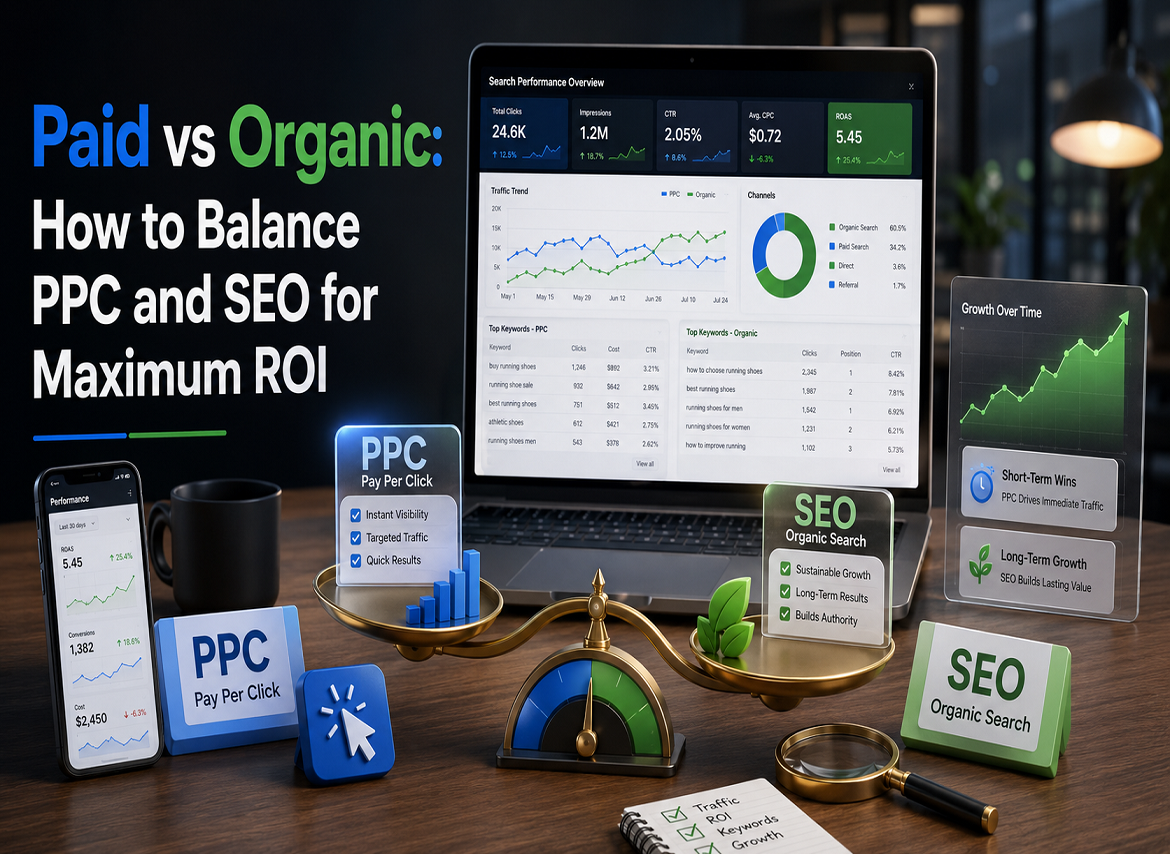

PPC advertising and SEO are generally seen as rival marketing approaches. PPC guarantees rapid visibility, though at ongoing cost, whereas SEO takes time but solid ranking will bring traffic even many years after the initial efforts.
It leaves us with a common dilemma for marketers: should we spend more money on paid campaigns or organic marketing?
In most cases, however, it’s the wrong question as far as the question is which ratio of PPC and SEO to use. Combined PPC and SEO will enable you to gain immediate traffic and valuable data from PPC, while growing authority and visibility through organic search.
The best-paid versus organic ratio doesn’t have any universal value since it largely depends on several factors.
Understanding the Difference Between Paid and Organic Search
Paid search refers to advertisements that appear across platforms such as Google Ads, Microsoft Advertising and Google Shopping. Businesses bid for visibility and usually pay when someone clicks an advert.
Organic search refers to unpaid listings earned through SEO. These results are influenced by website relevance, technical performance, content quality, user experience and authority.
PPC gives marketers more control over budgets, targeting, messaging and landing pages. SEO offers less immediate control, but it can create a stronger long-term presence across product, category and informational searches.
PPC is usually best for:
- Immediate visibility
- Product launches
- Seasonal campaigns
- Keyword and offer testing
- High-intent searches
- Audience remarketing
- Short-term revenue targets
SEO is usually best for:
- Long-term traffic growth
- Wider keyword coverage
- Product and category discovery
- Informational demand
- Website authority
- Sustainable brand visibility
- Reducing dependence on paid clicks
Neither channel is automatically more profitable. PPC ROI depends on click costs, conversion rate, average order value and customer lifetime value. SEO ROI depends on implementation costs, ranking potential, traffic quality and whether organic visitors convert.
Why PPC and SEO Should Work as One Search Strategy
When PPC and SEO teams operate independently, they often repeat the same research, use different keyword priorities and report success through separate metrics.
The PPC team may discover high-converting search terms that never reach the content team. The SEO team may create pages for high-volume keywords that generate traffic but little commercial value.
A connected SEO and PPC strategy solves this by creating one view of search demand.
Paid search provides fast data about clicks, costs, offers and conversions. Organic search shows where the brand already has authority, where competitors dominate and which topics can build sustainable visibility.
Instead of competing for credit, both channels should support the same commercial outcomes: stronger search presence, more qualified traffic, improved acquisition efficiency and higher revenue.
What PPC Contributes to Business Growth
PPC Provides Faster Visibility for Commercial Searches
A new website may take time to rank organically for valuable keywords. PPC can create immediate visibility while the SEO programme develops.
For example, a new furniture retailer may not yet rank for “solid oak dining table”. A targeted Google Ads campaign can place the brand in front of shoppers while the relevant category page is strengthened for organic search.
This makes PPC useful when speed matters or when the business needs to validate demand quickly.
PPC Helps Test Keywords, Offers and Landing Pages
SEO decisions often require significant time and content investment. PPC can provide earlier evidence about which keywords and messages attract qualified customers.
Campaigns can test:
- Search terms
- Headlines
- Promotions
- Product benefits
- Calls to action
- Landing pages
- Geographic demand
If a term generates clicks but no meaningful actions, it may have weak intent or require a different landing page. If another search term consistently produces sales, it may become a stronger priority for SEO.
PPC Offers Greater Control Over Targeting
Paid media campaigns can be adjusted by location, device, audience, time, product group and search intent.
This makes PPC especially useful for:
- Limited-time offers
- Regional campaigns
- Seasonal demand
- High-margin product categories
- New product launches
- Stock-clearance campaigns
Businesses can increase spend where performance is strong and reduce it where profitability is weak.
What SEO Contributes to Sustainable Growth
SEO Builds Long-Term Organic Visibility
Paid traffic usually declines when advertising spend stops. SEO can continue generating relevant traffic through product pages, category pages, service pages and helpful content.
Organic traffic is not free. Businesses still invest in strategy, technical improvements, content, design and authority building. However, there is no direct charge for every organic click.
Over time, strong organic visibility can reduce the pressure to purchase every visit through paid media.
SEO Reaches Customers Across the Buying Journey
PPC budgets are often focused on high-intent searches. SEO can support customers much earlier in the decision process.
For example, an ecommerce skincare brand may use paid search for “buy vitamin C serum” while SEO content targets questions such as:
- What does vitamin C serum do?
- How often should it be applied?
- Can it be used with retinol?
- Which ingredients help uneven skin tone?
These searches may not produce immediate sales, but they introduce the brand before the customer is ready to buy.
SEO Improves the Website Used by Paid Traffic
SEO includes more than content creation. It also covers site architecture, internal linking, product information, page speed, mobile usability and technical accessibility.
These improvements can also benefit PPC because paid visitors use the same website.
A faster product page, clearer category structure or stronger internal search function can improve both organic discovery and paid traffic conversion.
Businesses looking to strengthen these areas can explore Cresconnect’s ecommerce SEO services.
How to Balance PPC and SEO for Maximum ROI
Build a Shared Keyword and Search-Intent Framework
Start with one search strategy rather than separate PPC and SEO keyword lists.
For each important keyword group, review:
- Search intent
- Relevant landing page
- Organic position
- Paid campaign activity
- Cost per click
- Conversion rate
- Revenue potential
- Competitor visibility
- Content gaps
This helps teams decide whether a search term needs paid coverage, organic optimisation or both.
Commercial keywords may justify investment in PPC and SEO. Informational queries may be better suited to organic content when buying every click would be too expensive.
Use PPC Data to Prioritise SEO Opportunities
PPC can help validate whether a keyword has real commercial value before the business invests heavily in SEO.
For example, a retailer considering a major category page around “sustainable office furniture” could first test the theme through a focused paid campaign.
If the search terms produce qualified visits and conversions, the business has stronger evidence for creating or improving an organic landing page.
Paid data can also reveal:
- Customer language
- Stronger product benefits
- High-performing offers
- Better calls to action
- Converting geographic areas
PPC should not be the only source used for SEO decisions, but it can reduce guesswork.
Use Organic Search Insights to Improve PPC Campaigns
The exchange should work in both directions.
Google Search Console can reveal long-tail queries and customer terminology that may not yet appear in the PPC account. These insights can inform keyword targeting, ad copy and negative keywords.
Organic pages with strong engagement and conversion rates may also work well as paid landing pages, provided the advert matches the page intent.
SEO insights can help PPC teams identify:
- Emerging search demand
- New keyword themes
- Strong organic landing pages
- Seasonal interest
- Customer questions
- Competitor gaps
Match the Channel to the Search Intent
Not every keyword needs equal paid and organic investment.
Consider the intent behind the search.
“Buy waterproof hiking jacket” may justify both a paid campaign and an optimised ecommerce category page.
“How should a hiking jacket fit?” may be more suitable for an SEO guide.
“Best hiking jacket for winter rain” could support an organic comparison article, paid search testing and Shopping visibility.
The decision should be based on customer intent and commercial potential, not search volume alone.
Use PPC While SEO Visibility Is Still Developing
SEO takes time to build, particularly for new websites or highly competitive categories. PPC can provide immediate visibility while important pages gain authority and organic rankings.
Once organic performance improves, the business can test whether paid spend should:
- Remain at the same level
- Move to other keyword groups
- Focus on stronger offers
- Support seasonal campaigns
- Be reduced selectively
Do not automatically pause PPC because a page ranks organically. Paid listings can provide greater message control and may help the brand occupy more search-result space.
Use SEO to Reduce Unnecessary Paid Dependence
Some search terms may eventually produce stable organic traffic and sales without heavy paid support.
At that point, the business should test whether PPC is generating additional value or simply receiving credit for demand that organic search would have captured.
Branded search is a common example. Paid brand campaigns may protect visibility from competitors and promote specific offers. However, they should still be measured for incremental value rather than assumed to be essential.
Coordinate Landing Pages Across Both Channels
PPC landing pages need strong message matching and focused conversion paths. SEO pages need relevance, depth, crawlability and a logical position within the website.
A page can support both channels when it:
- Matches the search intent
- Loads quickly on mobile
- Explains the offer clearly
- Includes useful product information
- Shows credible trust signals
- Provides a clear call to action
- Is accessible to search engines
Dedicated PPC landing pages may still be useful for temporary promotions, but permanent commercial pages should support both paid and organic traffic wherever possible.
Plan PPC and SEO Together for Seasonal Campaigns
SEO for Christmas, Black Friday, summer sales or other seasonal periods should begin before demand peaks.
Organic pages need time to be discovered, indexed and improved. PPC can then increase visibility during the most commercially important weeks.
Instead of creating a new seasonal URL every year, consider maintaining evergreen pages and updating them before each campaign period. This can preserve page history and reduce repeated work.
Paid ads, email, social media and internal links can then support the same page during the campaign.
How PPC and SEO Work Together for Ecommerce Brands
Ecommerce businesses have additional opportunities to connect paid and organic activity across Google Search, Google Shopping, product pages and category pages.
Align Product Feeds With Product Page SEO
Google Merchant Center uses product data such as titles, descriptions, prices, availability and images for Shopping campaigns and eligible free listings.
These details should remain consistent with the ecommerce website.
Improving product titles and descriptions can support:
- Shopping advert relevance
- Organic product discovery
- Better website clarity
- Improved feed quality
- Stronger customer confidence
Product feed optimisation and product page SEO should therefore be treated as connected activities.
Optimise Category Pages for Paid and Organic Traffic
Category and collection pages can support ecommerce PPC and ecommerce SEO at the same time.
A strong category page should include:
- A clear category heading
- Relevant products
- Useful filters
- Logical sorting
- Concise introductory copy
- Related category links
- Buying guidance
- Helpful FAQs where appropriate
Avoid placing long blocks of copy above the product listing. Paid visitors should be able to shop quickly, while search engines should still receive enough context to understand the page.
Use SEO Content to Build Remarketing Audiences
Organic content often attracts customers before they are ready to purchase.
A shopper reading a guide about choosing a mattress may later respond to a paid advert featuring the relevant product collection, reviews or delivery benefits.
The follow-up message should reflect the customer’s earlier interest. Someone who read an educational article should not immediately receive an overly aggressive sales advert.
For paid campaign support, Cresconnect’s ecommerce PPC services can help connect Google Ads activity with wider ecommerce performance.
How Much Budget Should Go to PPC and SEO?
There is no universal budget split.
A new business may initially invest more in PPC because it needs immediate traffic and testing data. However, SEO should still begin early to prevent long-term dependence on paid acquisition.
A growing brand may move towards a more balanced investment, using PPC for revenue while SEO expands category visibility and non-branded traffic.
An established business with strong organic rankings may use PPC more selectively for product launches, Shopping campaigns, remarketing and competitive search terms.
Budget decisions should consider:
- Growth targets
- Profit margins
- Customer acquisition cost
- Customer lifetime value
- Cash flow
- Search competition
- Existing organic authority
- Available landing pages
- Seasonal demand
The right balance should change as performance and market conditions change.
How to Measure PPC and SEO ROI Together
Channel-specific reporting remains useful, but teams should also examine total search performance.
Measure shared commercial outcomes such as:
- Total search revenue
- New customers from search
- Customer acquisition cost
- Conversion rate
- Average order value
- Contribution margin
- Customer lifetime value
- Branded and non-branded traffic
- Assisted conversions
- Revenue by landing page
For PPC, monitor cost, click quality, conversion value, ROAS and CAC.
For SEO, monitor organic visibility, clicks, qualified traffic, conversions and revenue.
The goal is not to create perfect attribution. It is to understand whether the combined search marketing strategy is driving profitable and sustainable growth.
Common Mistakes When Combining PPC and SEO
Treating the Channels as Competitors
When PPC and SEO teams compete for budget or credit, useful data remains trapped in separate systems.
Using Different Keyword Priorities
Both channels should work from the same view of customer intent, products and commercial value.
Sending Paid Traffic to Weak Pages
Strong targeting cannot compensate for unclear offers, poor mobile usability or checkout friction.
Measuring SEO Only Through Rankings
Rankings matter, but traffic quality, leads and revenue are more important business outcomes.
Measuring PPC Only Through Platform ROAS
Advertising platforms may not show the complete customer journey. PPC data should be compared with analytics and ecommerce revenue.
Stopping One Channel Too Early
Profitable PPC does not remove the need for SEO, and strong organic rankings do not automatically make paid media unnecessary.
A Practical 90-Day PPC and SEO Strategy
Days 1–30: Build the Shared Foundation
Audit Google Ads, Google Search Console, GA4, Merchant Center and conversion tracking. Create a shared keyword map and identify high-value pages.
Days 31–60: Improve Pages and Test Demand
Strengthen priority product, category and service pages. Launch focused PPC tests around commercially valuable search themes.
Use paid data to refine offers, keywords and messaging while developing SEO pages around sustainable opportunities.
Days 61–90: Reallocate Investment Using Evidence
Compare paid and organic performance by keyword group, landing page and revenue outcome.
Increase PPC spend where it creates profitable demand. Continue SEO investment where organic visibility can grow. Reduce duplication only when testing shows limited incremental value.
When Should You Use PPC, SEO or Both?
Use PPC in case you need fast visibility, targetability, testing or demand generation.
Use SEO when long-term visibility, broader search presence and lesser dependency on paid clicks are important for you.
Both in case the search opportunity is of commercial importance to you.
A proper balance between paid and organic marketing approaches doesn’t imply allocation of the same budget to both approaches. It means proper utilization of the strengths of each approach.
Conclusion: Build One Search Strategy, Not Two Competing Channels
The PPC vs SEO discussion is a false dilemma.
PPC search offers the benefits of immediacy, control and experimentation. SEO search offers the benefits of authority, broader reach and more lasting traffic.
Achieving optimal ROI means leveraging both methods.
Apply the results of PPC campaigns to affirm demand, optimize communications and uncover converting search keywords. Apply SEO to improve your site, diversify your content and fulfill relevant demand. Then compare performance of both campaigns in relation to common metrics.
To assist in creating an integrated approach to search and other performance marketing programs, Cresconnect will help you tie together SEO, PPC and ecommerce performance.
FAQs
1. Is PPC Better Than SEO?
A: PPC delivers faster visibility, while SEO builds longer-term organic growth. Most businesses benefit from using both.
2. How Do You Balance PPC and SEO?
A: Use shared keywords, landing pages and revenue goals. Let PPC support immediate demand while SEO builds sustainable visibility.
3. How Can PPC and SEO Improve ROI?
A: PPC provides fast testing data, while SEO builds lasting traffic. Sharing insights helps reduce wasted investment.
4. When Should Ecommerce Brands Use PPC?
A: Use PPC for launches, seasonal offers, high-intent searches and campaigns that need immediate visibility.
5. Should You Run PPC for Keywords That Rank Organically?
A: Yes, when paid ads add incremental traffic, protect visibility or support a specific offer. Test before reducing spend.
6. Can SEO Reduce PPC Dependence?
A: Yes. Strong organic rankings can generate traffic without paying for every click, reducing long-term reliance on advertising.