

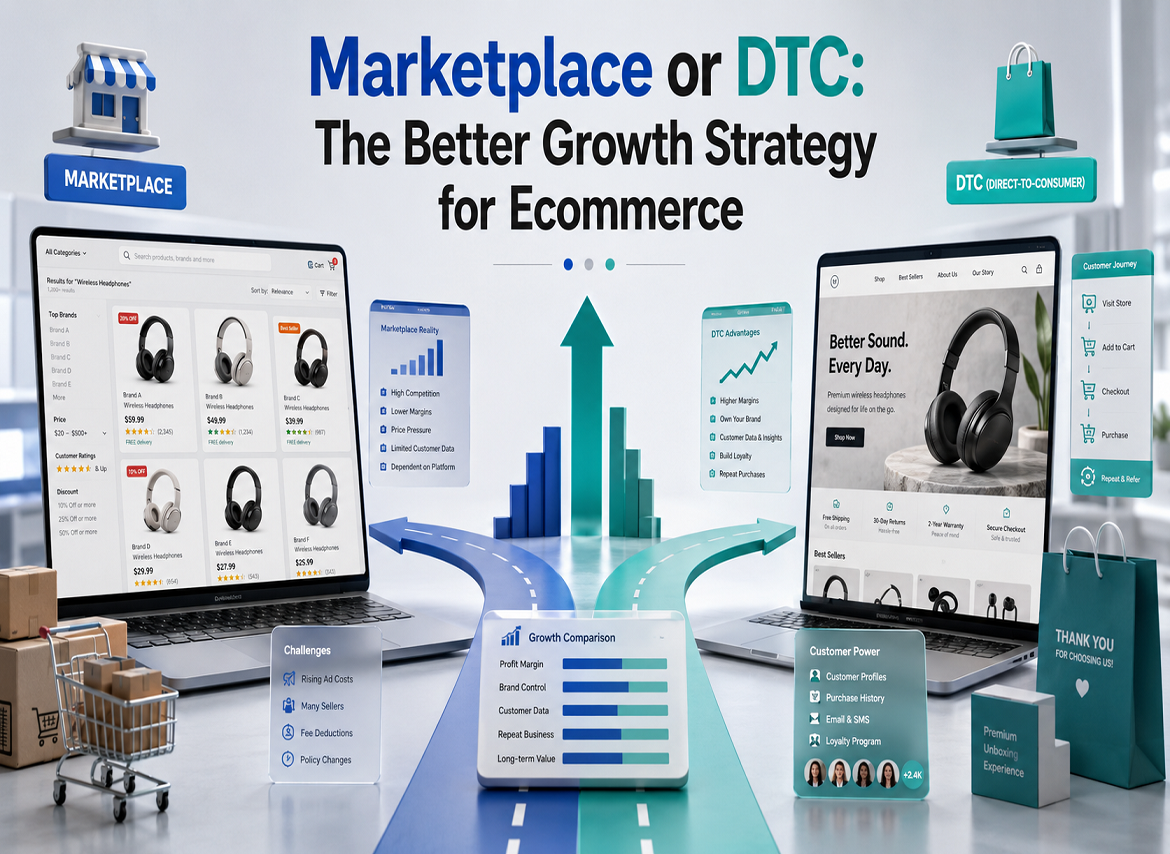

Ultimately, every ecommerce brand will face the growth challenge: Should I go for marketplace or DTC?
Initially, marketplaces might appear to be the path of less resistance. For example, platforms like Amazon, Flipkart, Myntra, Etsy, or eBay already have millions of consumers using them. You just have to list your products, run advertising campaigns, gather feedback from your potential buyers and start selling.
But direct-to-consumer (DTC) ecommerce requires a bit more efforts than going marketplace. It means that your brand won’t use any other platform, but will sell directly through your website, app or other digital channel you’ve created. And despite being more challenging, it provides more control over customer experience, marketing and branding, pricing policy, retention and profits.
Here comes the truth – there is no perfect solution. Both marketplace and DTC strategies offer something valuable, but the best choice will depend on your product category, margins, maturity of your brand, cost of customer acquisition and goals for the future.
At Cresconnect, we believe that marketplace and DTC strategies are just two distinct engines of growth.
What is Marketplace Selling?
Marketplace selling means offering your products on a third-party platform where customers are already browsing and buying. Instead of bringing every visitor to your own website, you use the platform’s existing traffic, search system, payment flow, trust, reviews, and fulfillment support.
For a new ecommerce brand, this can be very attractive. A marketplace gives you immediate access to shoppers who already have purchase intent. You do not need to convince them to trust an unknown website from day one. The platform has already done part of that work.
This is why marketplace selling often works well for brands that want quick validation. If you are launching a new product, marketplace performance can tell you whether people like the product, whether your price feels right, what customers mention in reviews, and which features matter most.
Amazon Seller University, for example, is an official learning resource that helps sellers understand Amazon’s selling tools, processes, services, and policies. This shows how marketplaces have become structured ecosystems where brands can learn, list, advertise, and scale with platform support.
But marketplace selling also has a cost. You are building sales inside someone else’s ecosystem. The customer often remembers the platform more than the brand. You may get revenue, but you may not get full customer ownership.
What is DTC Ecommerce?
DTC, or direct-to-consumer ecommerce, means selling directly to customers through your own online store, app, or owned sales channels. Instead of relying only on a marketplace, the brand manages the customer journey from discovery to purchase and post-purchase retention.
This gives a brand more control over how products are presented. A DTC website can explain the brand story, showcase product benefits, highlight reviews, educate buyers, recommend bundles, offer subscriptions, and build repeat purchase journeys through email, WhatsApp, SMS, loyalty programs, and remarketing.
Shopify describes DTC as selling directly to customers and highlights that DTC brands need to build their own audience because they do not automatically get the built-in reach of large retailers or marketplaces. This is why DTC brands often rely on influencer marketing, communities, SMS, email, paid ads, and owned content to create demand.
For brands that want to build stronger organic visibility on their own website, ecommerce SEO services can support product discovery, category growth, and long-term search performance.
Marketplace vs DTC: Key Differences
Marketplace and DTC can both drive revenue, but they create very different kinds of growth. A marketplace is often faster in the beginning, while DTC usually becomes more valuable when a brand wants ownership, repeat customers, and stronger margins.
Factor | Marketplace | DTC |
Customer Access | Built-in platform audience | Brand builds its own audience |
Brand Control | Limited | High |
Customer Data | Limited access | Owned first-party data |
Profit Margin | Lower due to fees and commissions | Higher potential, but needs marketing investment |
Competition | High, often price-led | More controlled brand environment |
Trust | Platform trust | Brand trust |
Retention | Difficult to control | Easier through owned channels |
Scalability | Faster, but platform-dependent | Slower, but more sustainable |
Customer Experience | Platform controls much of it | Brand controls the full journey |
The simplest way to understand it is this: marketplaces help you access demand, while DTC helps you create and own demand.
Why Marketplace Selling Can Help Brands Grow Faster
Marketplaces are useful because they reduce the friction of getting started. A new brand does not need to wait months to build traffic, rank on Google, or develop a large email list. It can start where the buyers already are.
This makes marketplaces especially helpful for early-stage brands that need proof. If a product performs well on Amazon, Flipkart, Myntra, or Etsy, the brand gets real-world feedback. Sales data, customer reviews, ratings, returns, and product questions can all help shape future decisions.
A marketplace growth strategy can also work well for products that are easy to compare. Categories like fashion accessories, electronics, home essentials, beauty products, FMCG, and gifting often perform well because customers already search for these products directly on marketplaces.
The platform also creates a trust advantage. Many customers feel safer buying from a known marketplace than from a new brand website. This trust can help reduce hesitation during the first purchase.
But this faster growth comes with a trade-off. The brand may win an order, but it may not win the customer relationship.
The Hidden Challenges of Marketplace Growth
Growth through marketplaces might seem impressive at first glance; however, there might be a darker side to it.
Firstly, there is the matter of margin pressure. Marketplace sellers tend to take commissions from each sale. The seller may charge referral fees, advertising fees, fulfillment fees, and any other service fees. So even if the product sells well, after all the deductions, the net margin of a product might become unexpectedly low.
Secondly, there is the problem of competition. A product will never appear by itself on the platform. Instead, it will be among similar products, sponsored items, lower-priced products, and even competing sellers providing the same or similar goods. This way, a brand finds itself in a constant struggle of price competition.
Thirdly, there is limited customer ownership. When selling on a marketplace, the customer is owned by the platform. One might not have full access to the customer’s data, which will make it harder to create loyalty and personalized communication.
Thus, relying solely on marketplaces might be risky. The terms of service might change, ad prices increase, competitors might offer better prices, and visibility will decline. If the brand has not worked on building an audience, the results might
Why DTC Ecommerce Builds Stronger Long-Term Value
The advantage of having a successful DTC commerce strategy is that it enables brands to own their customer journey end-to-end.
Every single element of customer experience, including product pages, product images, copy, reviews, check out process, post-purchase emails, packaging, customer service and even retention journeys is created by the brand.
This is important because in modern ecommerce business growth doesn’t mean simply driving the first purchase anymore. The ability to drive repeat purchases is key to growing a successful e-commerce business.
Since the DTC strategy enables brands to collect first-party data, analyze customer behavior and run personalized retention campaigns, this allows them to easily recommend additional products to the customers.
A skincare brand can personalize recommendations by creating a skincare routine depending on individual skin type. A fashion brand can recommend matching items. A supplements brand can send replenishment reminders. A home decor brand can make recommendations depending on style preferences.
DTC also offers much space for storytelling. If you sell premium, hand-made, ingredient-driven, sustainable, personalized or educational products, the owned channel will allow you to showcase all these aspects much better than the marketplace product pages.
In terms of ecommerce SEO strategy, Google publishes ecommerce SEO documentation that helps
The Real Challenges of Building a DTC Brand
DTC gives more control, but it also demands more discipline.
A DTC website does not come with built-in traffic. Brands need to create demand through SEO, paid ads, content, social media, influencer marketing, email, WhatsApp, SMS, referrals, and retention campaigns. This means customer acquisition can be expensive, especially in competitive categories.
The website experience also needs to be strong. A slow website, unclear product description, weak product images, confusing checkout, missing return policy, or lack of reviews can reduce conversions. In DTC, the brand is responsible for the full journey.
Trust also takes time. A marketplace gives customers platform-backed confidence. A DTC website has to build that confidence through reviews, secure payments, transparent policies, customer support, delivery clarity, and consistent brand communication.
Google’s SEO Starter Guide explains that SEO helps search engines understand content and helps users find a site and decide whether they should visit it. For DTC brands, this is especially important because owned search visibility can reduce dependency on paid acquisition over time.
DTC can become more profitable and defensible, but it is not a shortcut. It needs consistent investment in brand, search, content, conversion rate optimization, analytics, and retention.
Marketplace or DTC: Which is Better for Ecommerce Growth?
It really all depends on your business objectives.
If you are seeking more rapid validation of your sales model, marketplaces are the way to go. They can help you validate demand, gather feedback, test price points, and reach consumers already on the platform.
However, if your priorities are customer ownership, brand ownership, improved retention, and greater value creation, DTC is a superior platform.
For many ecommerce businesses, the solution is neither marketplace nor DTC. It is hybridization.
Marketplaces are used to help consumers find you. The DTC site is used to help them get to know you, like you, and return for more.
This is particularly useful when the brand is leveraging marketplaces as the acquisition channel and the DTC site as its brand-building engine._marketplace = reach.DTC = relationships.
When Marketplace-First Makes Sense
The marketplace-first strategy would be great for situations where the brand is currently gauging interest in their product.
This strategy would be appropriate for the product that is not too complicated and easy to benchmark against other products. Mobile accessories, home utility products, basics fashion products, and some beauty products usually sell well using this approach as the customer can easily compare price and delivery time.
When the marketing budget of the brand is low, then this kind of approach would be very helpful because the brand does not need to invest in getting website traffic right away.
In case of this strategy, the brand should not get addicted to the marketplace only and once it gains insight into its target audience and its selling product, it should build its own website and marketing infrastructure.
When DTC-First Makes Sense
DTC-first works better when the brand has a strong story, premium positioning, or a product that needs explanation.
A skincare brand, for example, may need to explain ingredients, skin types, routines, and product combinations. A premium saree brand may need to highlight fabric, craftsmanship, styling, and occasion suitability. A wellness brand may need to educate customers before they buy.
These products need more than a listing. They need context.
DTC-first also makes sense when repeat purchase potential is high. If customers can come back monthly, seasonally, or during gifting occasions, then owning the relationship becomes extremely valuable.
A brand with good margins, strong visual identity, and clear differentiation can benefit more from DTC because it can create a deeper customer journey rather than competing only on price.
Why a Hybrid Strategy Often Works Best
A hybrid strategy allows brands to use both channels without becoming dependent on either.
Marketplaces can be used for visibility, demand testing, customer acquisition, and category reach. DTC can be used for storytelling, retention, loyalty, customer data, margin improvement, and long-term brand building.
For example, a customer may first discover a product on Amazon. Later, they may search for the brand on Google, visit the website, read a buying guide, join a WhatsApp list, and purchase directly during the next campaign. This journey is common because shoppers do not think in channels. They move wherever trust, convenience, and value feel strongest.
A hybrid strategy also helps brands learn faster. Marketplace reviews can reveal customer objections. Website analytics can reveal browsing behavior. Email and WhatsApp campaigns can show repeat purchase patterns. Together, these insights can improve product development, ads, SEO, and retention.
As shoppers increasingly use AI assistants and voice-based journeys to find products, voice search for eCommerce should also become part of a brand’s long-term discovery strategy.
How to Build a Balanced Ecommerce Growth Strategy
Growth strategy for e-commerce begins with setting goals. Different brands have different objectives. They need money now or higher margins or more frequent repurchases or category authority. Choosing a proper channel mix should start with this goal.
First, look at your margins. If marketplaces and their commissions and paid advertising significantly affect your profit, then your DTC website requires more attention. Alternatively, DTC acquisition cost can be too high and therefore marketplaces can keep the flow of orders until owned channels get more mature.
Second, define your hero products – the best-sellers, the products which got good customer reviews and reflect your brand’s personality. These products should be promoted through all channels – marketplaces and your own website.
Your own website should have product pages which provide all necessary answers for the potential customers. Category pages should help them navigate. Blogs – educate. Checkout process – be smooth. Policies – inspire confidence.
Also, retention should become the priority. E-mail campaigns, WhatsApp messages, SMS, loyalty programs, subscriptions, post-purchase flows – all these things will help you to increase the lifetime value of your clients.
And without retention, your growth becomes very costly since you continue to pay acquisition cost each time you
Common Mistakes Ecommerce Brands Should Avoid
The biggest one is relying on marketplaces. While it may be good in the short term, in the long-term it makes the brand vulnerable to fees, changing policies, price pressures, and lack of customer ownership.
The second one is to build a DTC website and fail to optimize it correctly. The absence of SEO, good product pages, reviews, content, retention flows, and conversion optimization will make the website underperform despite its existence.
A third mistake is running ads but not retaining. It results in the dependence on continuous ad spending as the source of income. Instead, one should focus on turning one-time customers into returning through owned channels.
The fourth mistake is considering the marketplace and DTC strategies as independent efforts. Actually, they should be interconnected. Marketplace data could show what kind of products people like. DTC content could build authority around these products. Questions from the review section, FAQs, search queries, and support issues should help to make content for both channels.
The brands which evolve are the ones which see the connection between discovery, conversion, retention, and lifetime value.
Final Thoughts on Marketplace or DTC for Ecommerce Growth
So, which is better: Marketplace or DTC?
Marketplaces are better for reach, faster sales, and product validation. DTC is better for brand control, customer ownership, first-party data, retention, and long-term value.
For most ecommerce brands, the best answer is not to choose one and ignore the other. The smarter approach is to use marketplaces for discovery and use DTC to build the brand relationship.
A marketplace can help you get found. Your own website can help you get remembered.
If your brand is currently dependent on only one channel, now is the right time to review your growth model. Look at your margins, repeat purchase rate, customer acquisition cost, website performance, marketplace fees, and long-term brand goals.
At Cresconnect, we help ecommerce brands build stronger owned growth through SEO, content strategy, conversion-focused planning, and channel clarity. The goal is not just to sell more today, but to build a brand that can grow sustainably tomorrow.
FAQs:
1. What is the difference between marketplace and DTC ecommerce?
A: Marketplace ecommerce means selling through third-party platforms like Amazon, Flipkart, Myntra, Etsy, or eBay. DTC ecommerce means selling directly through your own website or app. Marketplace gives faster access to shoppers, while DTC gives stronger control over brand, customer data, and retention.
2. Is marketplace or DTC better for ecommerce growth?
A: Marketplace is better for quick visibility and demand testing. DTC is better for brand control, customer ownership, and long-term profitability. For many ecommerce brands, a hybrid strategy works best because it uses marketplaces for reach and DTC for retention and brand-building.
3. Should ecommerce brands sell on marketplaces and their own website?
A: Yes, many ecommerce brands should use both. Marketplaces can help attract new customers, while the brand’s own website can create a stronger customer experience, collect first-party data, improve retention, and build long-term brand value.
4. Why is DTC important for long-term brand growth?
A: DTC is important because it allows brands to own the customer relationship. A DTC website gives brands control over storytelling, pricing, product education, customer data, retention campaigns, loyalty programs, and post-purchase communication.
5. What are the risks of depending only on marketplaces?
A: The main risks include high platform fees, price competition, limited customer data, weak brand recall, dependency on platform algorithms, policy changes, and lower control over customer experience.
6. How can ecommerce brands build a hybrid growth strategy?
A: Brands can use marketplaces for discovery and demand validation, while using their DTC website for brand storytelling, SEO, retention, customer data, and repeat purchases. The best hybrid strategies connect marketplace insights with owned-channel growth.