


Introduction
Many ecommerce brands reach a point where growth starts to feel expensive.
Sales are coming in, but ad costs keep rising. Meta Ads need more budget. Google Ads becomes more competitive. Discounts are used more often, and acquiring new customers starts to cost more than expected.
At this stage, many brands ask the same question:
How do we keep growing without spending more on ads?
The answer is not always more traffic. Sometimes, the biggest growth opportunity is already inside your existing customer base.
That is where ecommerce lifetime value becomes important.
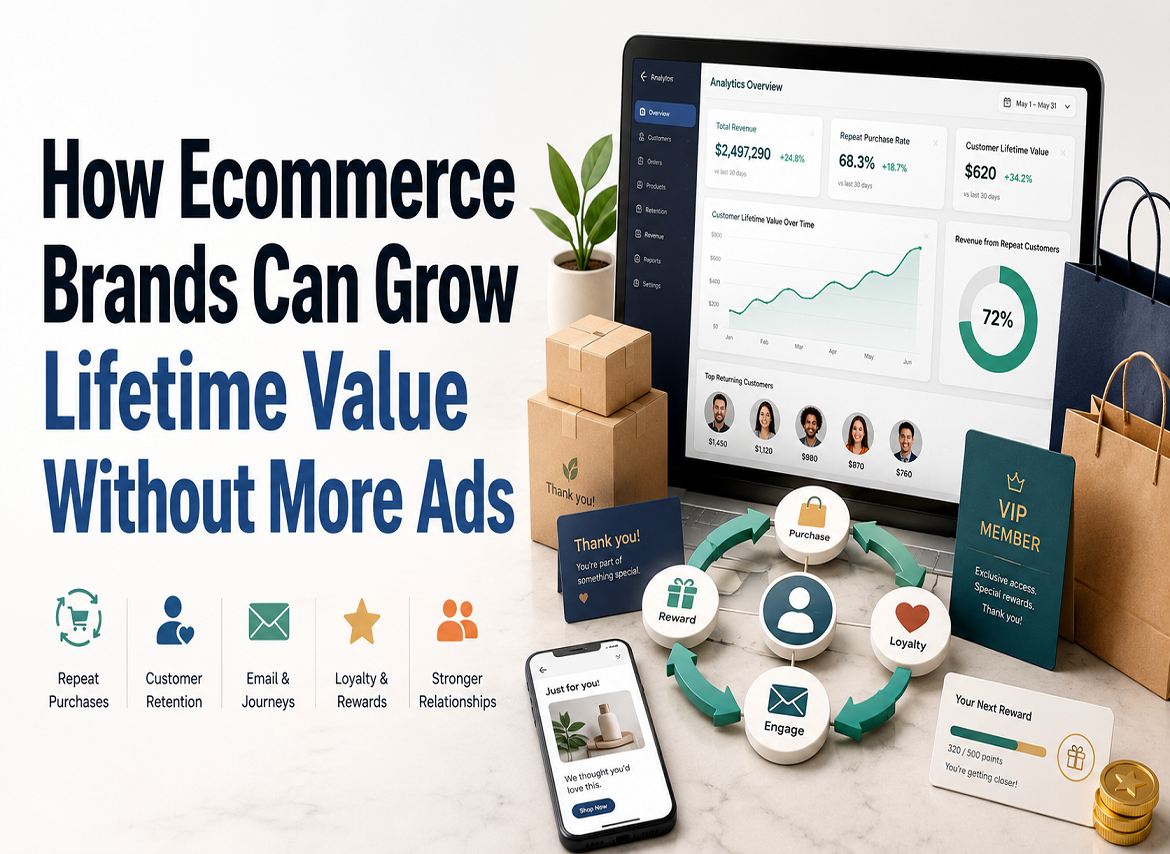
Customer lifetime value, also known as LTV or CLV, shows how much revenue a customer can bring to your business during their full relationship with your brand. If customers buy once and never return, your store has to keep paying to acquire new buyers. But if customers return, spend more, and stay engaged, your ecommerce business becomes more profitable over time.
For growing ecommerce brands, especially D2C brands, improving ecommerce lifetime value can reduce pressure on paid ads. It can help increase repeat revenue, improve customer loyalty, lift average order value, and make every acquisition campaign more valuable.
This blog explains how ecommerce brands can grow lifetime value without increasing ad spend, and how a balanced strategy across SEO, CRO, retention marketing, customer experience, and website optimisation can support more sustainable growth.
What Ecommerce Lifetime Value Really Means
Ecommerce lifetime value refers to the total value that a customer generates to your ecommerce store over his/her entire time purchasing from your store.
LTV could be calculated as:
Customer Lifetime Value = Average Order Value x Purchase Frequency x Customer Lifespan
In case of one customer spending £60 on average per order, making 4 purchases per year and staying with you for 2 years, the lifetime value would be £480.
With the use of LTV, ecommerce founders would be able to see which customers are more valuable to their business, how much can be spent on acquiring them and what needs to be done to improve customer retention.
From the perspective of an ecommerce founder, LTV is a crucial metric as it directly impacts how much can be spent on customer acquisition, profitability of your brand, and sustainability of the growth strategy.
The brands with low LTV have to constantly acquire new customers while those with high LTV get better value out of their existing customers.
This is the reason why ecommerce LTV needs to be in the center of your growth strategy.
Why More Ads Are Not Always the Answer
Paid ads are useful. They can help ecommerce brands reach new customers, test offers, promote products, and generate faster traffic.
But paid ads alone cannot fix weak customer value.
If a store has low repeat purchase rate, poor product page experience, weak post-purchase communication, poor customer service, or no retention strategy, more ads may only bring more one-time buyers.
That creates a common ecommerce cycle:
The brand spends more on ads. New customers come in. Some customers buy once. Very few customers return. Revenue depends on the next campaign. CAC rises, and profitability becomes harder.
This is not only a traffic problem. It is a customer value problem.
More ads can increase reach, but they do not automatically increase loyalty. They do not guarantee repeat purchases. They do not improve the website experience. They do not fix cart abandonment. They do not make customers trust the brand more after the first order.
That is why ecommerce brands need a stronger balance between acquisition and retention.
Paid ads bring customers in. Retention, CRO, content, SEO, customer experience, and post-purchase journeys help bring them back.
Want to grow revenue without relying only on paid ads?
Schedule a Free Consultation with Cresconnect and get expert guidance on ecommerce SEO, PPC, CRO, and retention-focused growth.
How Rising CAC Makes LTV More Important
Customer acquisition cost, or CAC, is the amount your business spends to acquire a customer.
When CAC rises, every new customer becomes more expensive. This is common in competitive ecommerce markets where more brands are bidding for the same audience across Google Ads, Meta Ads, shopping campaigns, and retargeting.
If LTV is low, rising CAC becomes a serious problem. The business spends more to acquire customers but does not earn enough from them over time.
If LTV is strong, the brand has more room to invest in acquisition because each customer is worth more across their full journey.
This is why ecommerce brands should not review CAC and LTV separately.
A brand may have a high acquisition cost, but if repeat purchase rate, AOV, and retention are strong, the numbers may still work. On the other hand, a brand may have a low CAC but still struggle if most customers only buy once.
The goal is not only to reduce CAC. The goal is to make every acquired customer more valuable.
The Metrics That Influence Ecommerce Lifetime Value
To grow ecommerce lifetime value, brands need to understand which metrics shape it.
Metric | Why It Matters for LTV |
Average Order Value | Higher AOV increases the value of every purchase |
Purchase Frequency | More repeat purchases increase total customer value |
Customer Lifespan | Longer customer relationships create more revenue over time |
Repeat Purchase Rate | Shows whether customers are coming back |
Retention Rate | Measures how well the brand keeps customers active |
Churn Rate | Shows how many customers stop buying |
Gross Margin | Helps check whether customer value is profitable |
Cart Abandonment Rate | Shows where revenue may be leaking before purchase |
Ecommerce analytics can help brands track shopping behaviour, including product views, add-to-cart actions, checkout starts, purchases, refunds, and promotions. This kind of tracking helps ecommerce teams understand where customers engage, where they drop off, and which products influence revenue.
The more clearly you track these metrics, the easier it becomes to improve customer lifetime value.
How Ecommerce Brands Can Increase Lifetime Value Without More Ads
Growing ecommerce lifetime value does not depend on one tactic. It requires improving the customer journey before purchase, during purchase, and after purchase.
Improve the Post-Purchase Experience
Many ecommerce brands focus heavily on getting the first order but pay less attention to what happens after the customer buys.
That is a mistake.
The post-purchase experience strongly influences whether a customer comes back. If delivery updates are unclear, product usage is confusing, support is slow, or the customer never hears from the brand again, repeat purchase becomes less likely.
A strong post-purchase journey can include order confirmation emails, delivery updates, product usage tips, care guides, review requests, replenishment reminders, and personalised recommendations.
For example, a skincare brand can send a routine guide after purchase. A fashion brand can send styling ideas. A home decor brand can suggest matching products. A food brand can send recipes or refill reminders.
This keeps the customer engaged beyond the first transaction.
Increase Repeat Purchase Rate With Better Timing
Repeat purchase rate is one of the biggest drivers of ecommerce lifetime value.
If customers usually repurchase after 30 days, but the brand sends a reminder after 90 days, the timing is too late. If customers need product education before buying again, but the brand only sends discounts, the message may not be helpful enough.
To improve repeat purchase rate, ecommerce brands should study buying patterns.
When do customers usually come back? Which products lead to repeat orders? Which customer segments buy more than once? Which first purchases often lead to a second purchase?
Once you know this, you can build better email, SMS, and WhatsApp journeys.
Retention marketing works best when it is based on customer behaviour, not random promotional blasts.
Use Customer Segmentation
Not every customer should receive the same message.
A first-time buyer needs a different journey from a loyal customer. A high-value customer should not be treated the same as someone who purchased once during a discount sale. A cart abandoner needs a different message from a repeat buyer.
Customer segmentation helps brands communicate more intelligently.
Useful segments include first-time buyers, repeat customers, high-AOV customers, discount-driven customers, inactive customers, VIP customers, cart abandoners, and category-specific buyers.
Segmentation improves relevance. Relevance improves engagement. Better engagement can lead to higher repeat purchase rate and stronger customer lifetime value.
Use Email and WhatsApp Marketing for Lifecycle Growth
Email and WhatsApp marketing can help ecommerce brands grow revenue from existing customers without increasing ad spend.
The goal is not to send more messages. The goal is to send better messages at the right time.
Useful lifecycle campaigns include welcome flows, abandoned cart reminders, post-purchase education, replenishment reminders, cross-sell campaigns, review requests, winback campaigns, and loyalty updates.
For example, a customer who buys a pair of shoes may later receive styling ideas, care tips, matching accessories, and a loyalty reward. A customer who buys a supplement may receive a reminder before the product is likely to run out.
This kind of lifecycle marketing makes customers feel guided rather than pushed.
Improve Product Pages So Customers Buy With Confidence
Product pages affect both first-time purchases and repeat purchases.
If product pages are unclear, customers may hesitate before buying. If expectations are not set properly, customers may feel disappointed after delivery. That can hurt retention.
A strong ecommerce product page should include clear product images, useful descriptions, sizing or usage information, delivery details, return information, customer reviews, FAQs, trust signals, and related product suggestions.
Strong product data, clear site structure, and helpful content can support both SEO and customer experience.
This is where ecommerce SEO services and ecommerce CRO services work together. SEO helps bring the right customers to the site. CRO helps turn those visitors into buyers. A better product experience helps bring them back.
Increase AOV Through Bundles, Cross-Sells, and Upsells
Average order value is another important LTV driver.
If customers spend more per order and continue buying, lifetime value grows without needing more ad spend.
Product bundles are especially useful because they make the buying decision easier. A skincare routine bundle, festive outfit set, home essentials bundle, or gifting bundle can increase order value while improving customer experience.
Cross-selling and upselling should feel helpful, not forced.
A good cross-sell answers the question: what else would make this purchase more useful?
When done well, bundles, cross-sells, and upsells increase AOV and improve customer satisfaction.
Build Loyalty Without Overusing Discounts
Discounts help to boost immediate sales figures, but they might actually teach your customers to wait for offers.
Loyalty strategies work better by providing customers with some motivation to come back besides prices.
It could be reward points, early access to products, special discounts for members, birthday gifts, referral bonuses, VIP memberships, personalized suggestions, exclusivity, or anything else.
The point is to make customers feel valued.
Loyalty is not just about rewards. It is also about trust, consistency, product quality, and experience.
Use SEO and Content Marketing to Support Retention
SEO is often seen as an acquisition channel, but it can also support lifetime value.
Helpful content can keep customers connected before and after purchase. Product guides, comparison blogs, styling tips, care instructions, gift guides, buying guides, FAQs, and educational articles can all support customer confidence and repeat buying.
For example, a saree brand can publish styling and care guides. A skincare brand can publish routine guides. A DIY toy brand can publish project ideas. A fitness brand can publish usage and training content.
With content marketing services and SEO services, ecommerce brands can build a content ecosystem that supports both organic traffic and repeat customer engagement.
LTV Growth vs Paid Acquisition Growth
Area | More Paid Ads | LTV Growth |
Main Goal | Acquire more new customers | Increase value from existing customers |
Primary Cost | Ad spend | Retention, CRO, content, and customer experience |
Best For | Short-term traffic and reach | Long-term profitability |
Main Risk | Rising CAC and lower ROAS | Needs consistent customer engagement |
Key Metrics | CPC, CTR, CAC, ROAS | LTV, repeat purchase rate, AOV, retention rate |
Business Impact | More traffic | More profitable customer relationships |
Both approaches matter. The strongest ecommerce brands do not choose between paid ads and LTV growth. They use both.
Paid ads bring in the right customers. LTV strategies help those customers return.
How Cresconnect Helps Ecommerce Brands Grow Lifetime Value
Cresconnect supports ecommerce brands in driving sustainable growth by improving visibility, traffic quality, conversions, and overall performance through a combination of SEO, PPC, CRO, web design, content marketing, and ongoing website support.
Increasing ecommerce lifetime value is not achieved through a single channel. It requires a connected strategy that strengthens every stage of the customer journey, from discovery to repeat purchase.
Ecommerce brands can improve organic visibility by focusing on well-structured product and category pages, supported by content that answers customer questions and builds trust over time.
Paid campaigns can also become more effective when landing pages match user intent and messaging stays consistent across ads and on-site experiences. This helps ensure that ad spend contributes to meaningful, long-term growth rather than just short-term results.
Improving the on-site experience is equally important. Clear product pages, smooth navigation, and a simple checkout process can reduce friction and make it easier for customers to complete purchases. Small improvements in usability often lead to better conversion rates and higher value from existing traffic.
Alongside this, thoughtful web design and well-planned content can make a significant difference. When a website is easy to use and information is presented clearly, customers are more likely to engage, trust the brand, and return in the future.
When these elements work together, ecommerce brands can reduce their reliance on constant ad spend and build stronger, more valuable customer relationships over time.
Conclusion: Grow Lifetime Value Before You Spend More on Ads
More ads can bring more traffic, but traffic alone does not build a stronger ecommerce business.
If customers buy once and never return, growth becomes expensive. If product pages do not build confidence, conversion suffers. If post-purchase journeys are weak, retention drops. If SEO and content are ignored, brands miss opportunities to educate, guide, and re-engage customers.
Growing ecommerce lifetime value helps brands get more from the customers they already have. It improves repeat purchases, customer loyalty, AOV, retention, and long-term profitability.
Cresconnect helps ecommerce businesses grow through connected SEO, PPC, CRO, web design, content marketing, and ecommerce optimisation. If your brand wants to increase customer lifetime value without relying only on more ads, speak to the Cresconnect team and schedule a free consultation.
FAQs
1. What is an ecommerce lifetime value?
A: Ecommerce lifetime value is the total revenue a customer is expected to generate during their relationship with an online store. It is influenced by average order value, purchase frequency, customer lifespan, retention rate, and repeat purchases.
2. How can ecommerce brands increase LTV without more ads?
A: Brands can increase LTV by improving customer retention, post-purchase journeys, email marketing, WhatsApp marketing, loyalty programmes, product bundles, cross-selling, upselling, CRO, SEO content, and customer experience.
3. Why is customer retention important for ecommerce LTV?
A: Customer retention helps brands generate more revenue from existing customers. When customers return, the brand depends less on constant new customer acquisition and can improve profitability over time.
4. What metrics should ecommerce brands track to improve lifetime value?
A: Important metrics include LTV, CAC, AOV, repeat purchase rate, purchase frequency, retention rate, churn rate, gross margin, customer segments, cart abandonment rate, and customer profitability.
5. Can SEO help increase customer lifetime value?
A: Yes. SEO can support LTV by bringing in better-quality organic traffic and creating helpful content that guides customers before and after purchase. Buying guides, care guides, product comparisons, and FAQs can support repeat purchases.
6. How does CRO improve lifetime value?
A: CRO improves lifetime value by reducing friction across product pages, landing pages, checkout, and the overall buying journey. A smoother experience makes customers more likely to buy and return.