

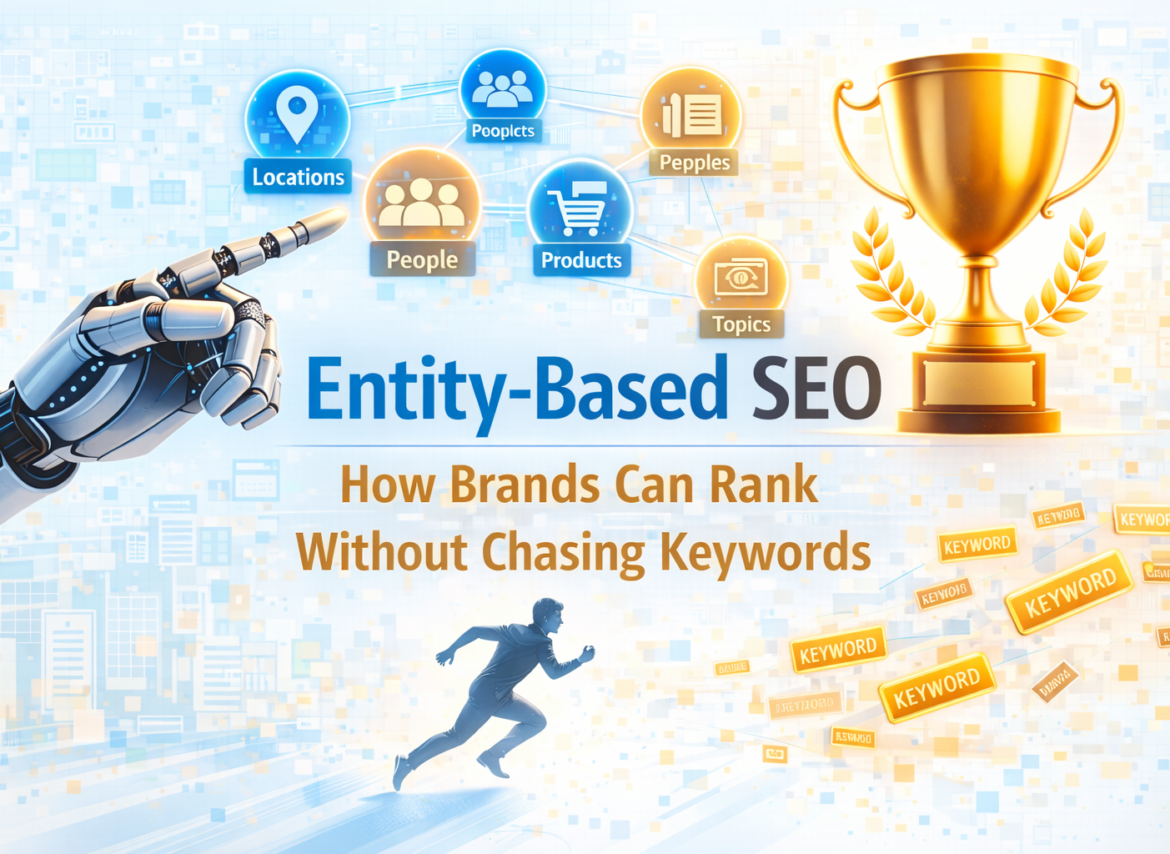

Earlier, brands used to rely on identifying popular search terms to boost their organic reach. But in the modern SEO strategy, search engines have evolved to be able to identify the search intent more than focus on keywords, based on context, by using relationships between topics when processing user queries and displaying search results.
Therefore, brands now need to change their focus from “What keyword do I want to rank for?” to “What topic do I want people to see me as an authority on?” This new way of thinking has transformed SEO from the tactical placement of keywords to the strategic building of SEO authority. We will explore this concept of intent-based entity SEO in the blog.
Google Understands Topics, Not Just Words
To find out what is relevant within a website, search engines take advantage of new technologies such as Natural Language Processing (NLP) and other organised databases like Google’s Knowledge Graph to understand the relationship between entities, which can be a personality, brand, idea, place, product, or even a concept. When Google views the content of a page, it doesn’t just see the words; it also associates entities and measures how closely related they are.
To illustrate this point, if a particular website consistently links to the subjects of technical SEO, structured data, schema markup, and site architecture, then it gives Google a strong basis to consider that website an authoritative source in technical SEO. This can be termed as entity SEO.
Why Brands Struggle When They Only Focus on Keywords
Brands that focus only on keywords for SEO create content that is disconnected from each other. For example, although “best SEO tools” is one example of a target keyword, there are also other keyword phrases such as “SEO checklist” and “SEO tips.” These types of keywords are great for ranking temporarily, but they’re not contributing to building SEO authority due to the lack of a robust entity-based SEO.
Without content having topical depth or being structurally related, the content is going to compete instead of compounding. For these reasons, the modern SEO strategy requires a movement towards focusing on entities as well as topical authority SEO.
What Is Entity SEO and How It Works
Understanding Entities in Search Engines
Entity-based SEO focuses on optimising content around specific topics with their corresponding attributes or entities. An entity is more than just a keyword; an entity is an idea, thing, or concept that relates to semantic search, structured data, and topical authority.
Search engines evaluate the quality of your content to describe the entity being targeted. That means the search engine will evaluate the following things to identify the target entity: definitions, related entities, examples of that entity, context relating to that entity, and consistency of your website overall in regard to the entity.
How Knowledge Graph Connections Strengthen SEO Authority
Entities are mapped to structured networks by search engines. When an entity publishes related content regularly, it increases the entity’s relationship. Because of this, the SEO authority is built over time.
For example, if your core entity is a modern SEO strategy, the associated entities would include technical SEO, content optimisation, user experience signals, internal linking and schema markup.
When all of these are tied together in a logical manner and published frequently, they build credibility with search engines. This interconnectedness differentiates between an authoritative website and random content.
With traditional SEO practices, you target a single keyword. With entity-based SEO, you cover a topic as a whole. With keywords for SEO, success is based on using an exact match between the keywords and the content. With entity SEO, success is based on the depth and meaning of the context and using those keywords in a semantically related manner.
Keyword-based pages tend to compete with one another. Entity-based pages tend to support one another. This collaborative structure builds stronger ranking signals and ultimately enhances the performance of the pages over time.
Building SEO Authority Through Topical Authority SEO
What Is SEO Authority in 2026?
Topical authority in SEO is the quantity and quality of perceived knowledge that a website demonstrates with respect to a subject matter. This requires you to develop your own expertise using multiple content types that demonstrate your knowledge base.
Search engines reward websites with demonstrated clarity and experience using the principles of E-E-A-T: experience, expertise, authority and trust.
How Topical Authority SEO Builds Trust and Relevance
When creating a range of articles within a single core entity that link to each other, search engines receive a positive signal identifying a common theme. Additionally, as users spend more time exploring a topic, it increases the likelihood that further build SEO authority.
You should create a structured content cluster rather than creating random post types to identify one primary entity and have multiple subsets of that entity in your content. Each content cluster should focus on one primary entity while expanding on multiple sub-entities, providing additional detail for each sub-entity.
Create Content Clusters Around Core Entities
Content clusters are becoming increasingly important within the SEO landscape today. To build your content clusters, you first need to define your main entity, then list all the subtopics that relate to it. Each subtopic should have its own distinct article that links back to the main page.
For example, if you have a pillar page for entity SEO, that page can link to separate articles about topics such as semantic search, structured data implementation, and internal linking strategy.
By using this approach to create structured content, you reinforce how entities relate to one another while also establishing your website’s overall SEO authority within the entity space.
Conclusion: Building Topical Authority through Entity-based SEO
To sum it up, using entity SEO strategies goes beyond trying to achieve a high ranking. Instead, it builds a long-lasting foundation for building expertise and topical coverage. When brands focus on the relationships between entities as opposed to keywords for SEO, they create an ecosystem of content that continues to grow in strength over time.
Brands that invest in building an entity-based SEO strategy are in a much better position to succeed. By creating content based on entities, by reinforcing their internal relationships, and by consistently demonstrating their expertise, brands create lasting credibility as trusted sources of information.
Therefore, using an entity-based SEO strategy in today’s world of semantic search represents the most sustainable long-term strategy for building your business.