

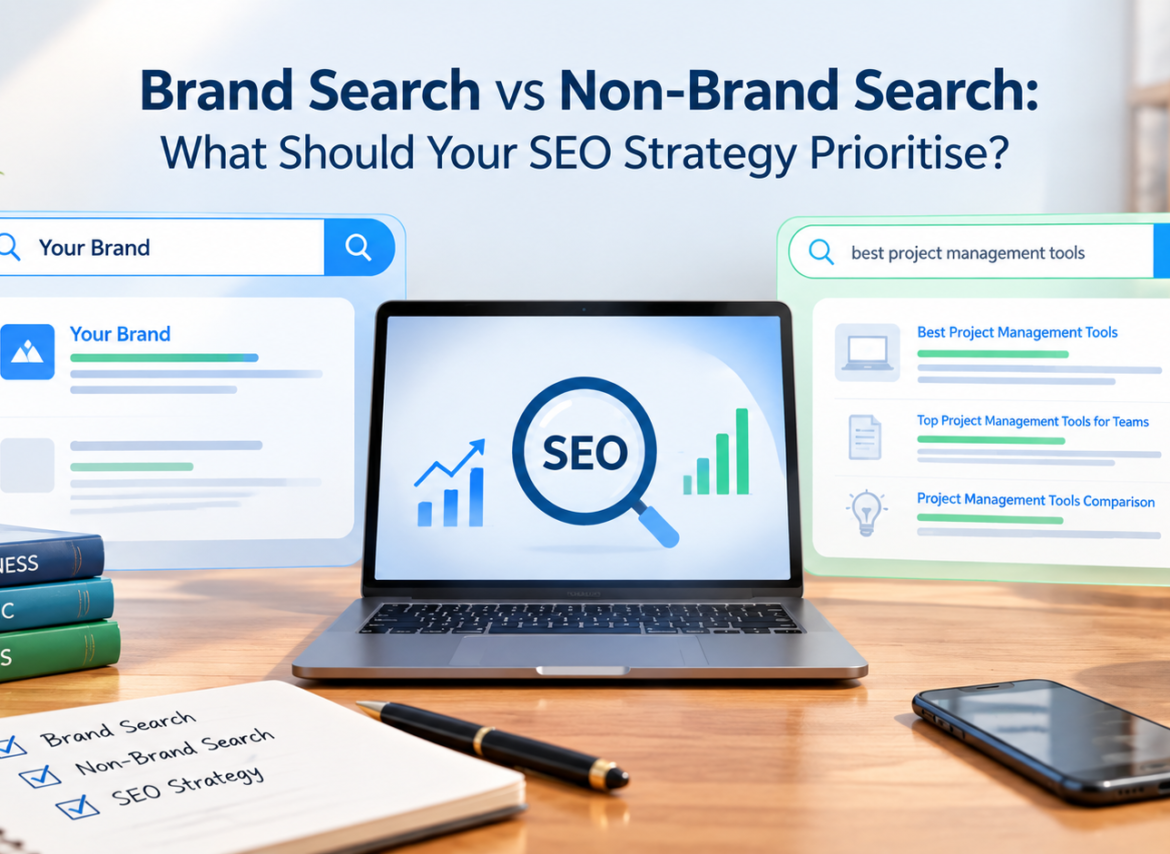

Organic traffic can look impressive on a report.
But there is an important question sitting behind that number:
Are people finding you because they already know your brand, or because your SEO helped them discover you?
That is the difference between brand search and non-brand search.
Someone searching for “Cresconnect SEO” already knows the name Cresconnect. Someone searching for “ecommerce SEO agency London” may have never heard of Cresconnect before.
Both searches matter.
But they tell you very different things about how well your SEO strategy is working.
Google Search Console now includes branded and non-branded traffic insights for eligible properties. Google explains that branded traffic comes from people specifically searching for a brand, while non-branded traffic comes from more general searches. The classification is AI-powered and can occasionally mislabel queries.
A healthy SEO strategy should do two things at the same time:
help new people discover your brand and make it easy for people who already know you to find the right information.
So rather than asking whether brand or non-brand search is more important, the better question is:
What role should each one play in your SEO growth?
What Is Brand Search in SEO?
Brand search means someone searches using your company name, product name or another term closely connected to your brand.
For Cresconnect, that might look like:
- Cresconnect
- Cresconnect SEO
- Cresconnect ecommerce SEO
- Cresconnect reviews
- Cresconnect PPC
These are branded keywords because the searcher already knows something about the business.
They may have seen an ad.
They may have found the brand on LinkedIn.
Someone may have recommended it.
Or they may have visited the website before.
That is important because branded traffic does not always mean SEO created the demand.
SEO may simply be capturing demand that another channel created.
Research published in the Journal of Interactive Marketing found that people actively shopping within a category were more likely to search for brands, while greater brand familiarity and consideration were also associated with increased branded searching. The research covered specific product categories, so it should not be treated as a universal benchmark.
What Is Non-Brand Search in SEO?
Non-brand search happens when someone searches for a problem, service, product or topic without mentioning a specific company.
Examples could include:
- ecommerce SEO agency
- SEO services London
- how to improve ecommerce rankings
- ecommerce keyword research
- increase organic traffic
These are non-branded keywords.
The person searching may not know your business exists yet.
That is what makes non-brand traffic so useful.
It shows whether your website can compete for attention before someone has already chosen a brand.
This is also why keyword strategy should go beyond search volume. Cresconnect’s guide on moving from keywords to search intent explains why understanding what the user actually wants is often more useful than simply targeting the biggest keyword.
Brand Search vs Non-Brand Search: The Difference
Factor | Brand Search | Non-Brand Search |
Example | “Cresconnect SEO” | “ecommerce SEO agency” |
Brand awareness | Usually already exists | May not exist yet |
Main role | Capture demand | Create discovery |
Typical intent | Navigational or commercial | Informational or commercial |
Growth value | Supports conversion | Expands reach |
Common pages | Homepage, service, review pages | Service pages, guides, blogs |
The simplest way to think about it is this:
Brand search captures people who already know you. Non-brand search helps more people find you in the first place.
Why Non-Brand Search Matters for SEO Growth
Imagine two businesses both receive 50,000 organic visits a month.
At first glance, they look equally successful.
But now look closer.
Business A
- 40,000 visits come from branded searches.
- 10,000 come from non-brand searches.
Business B
- 15,000 visits come from branded searches.
- 35,000 come from non-brand searches.
The total traffic is the same.
The growth story is not.
Business B is being discovered by far more people who did not necessarily start by looking for that company.
That is why non-brand search traffic is one of the clearest ways to understand whether SEO is expanding your visibility.
It can also bring people into your funnel much earlier.
For example, someone may search: “best ecommerce SEO agency”
They discover a company through that search.
A few days later, they search:“Cresconnect reviews”
That journey started with non-brand discovery and moved into branded evaluation.
Why Branded Search Still Matters
It would be a mistake to focus only on non-brand keywords.
Branded search is often where interest becomes more serious.
Someone searching your company name may be comparing services, checking reviews or deciding whether to contact you.
They might search for:
- Brand + reviews
- Brand + pricing
- Brand + services
- Brand + alternatives
- Brand + location
- Brand A vs Brand B
This means branded SEO is about more than ranking for your company name.
You need to make sure the right page appears for the right brand-related question.
A person looking for reviews should not have to dig through your homepage.
A person looking for a specific service should land somewhere that clearly explains that service.
Trust matters here too. Cresconnect’s guide to building trust signals that support stronger search visibility explains why clear company information, expertise and credibility can influence how people respond once they find you.
Why Total Organic Traffic Can Be Misleading
This is where many SEO reports fail.
They state:Organic traffic grew by 30%
That’s great!
But why did it grow?
Consider an instance where a company launches an intensive paid campaign.
Awareness grows.
People search for the company name on Google.
Traffic grows organically.
But SEO might just be taking credit for something the marketing department is responsible for generating.
It doesn’t mean that the traffic isn’t important.
It only means that you need to know where the growth originated.
An ideal SEO report would be:
- Has branded traffic grown?
- Has non-branded traffic grown?
- Have there been any new keyword gains?
- Have old rankings improved?
- Have CTRs improved?
- Have conversion rates increased?
- Have there been gains in the visibility of landing pages?
Google Search Console defines clicks, impressions and average position as separate search-performance metrics, which is why traffic alone should not be the only measure used to judge visibility.
Without separating brand and non-brand traffic, it is easy to tell the wrong story.
So, Should SEO Prioritise Brand or Non-Brand Keywords?
There is no fixed answer.
It depends on where the business is in its growth journey.
If You Are a Newer Brand
Non-brand search usually deserves more attention.
Few people know your name yet, so growth depends on being found for the problems, products and services people are already searching for.
Focus on:
- category keywords;
- problem-based searches;
- commercial-intent terms;
- educational content.
If You Are a Growing Brand
You need both.
As awareness increases, branded search will naturally become more important.
At this stage, separate brand and non-brand traffic in your reporting so you can see whether SEO is still expanding beyond existing demand.
If You Are an Established Brand
You may already dominate branded results.
The bigger opportunity could be increasing non-brand search visibility across new services, categories or topics.
Cresconnect’s guide to building a long-term SEO roadmap is useful here because the balance should change as the business grows.
How to Measure Brand and Non-Brand Search Traffic
Start with Google Search Console.
Separate branded and non-branded queries, then compare:
- clicks;
- impressions;
- CTR;
- average position;
- conversions;
- landing pages;
- query themes.
Two useful calculations are:
- Branded Click Share = (Branded Clicks/Total Organic Clicks)*100
- Non-Brand Click Share = (Non-Branded Clicks/Total Organic Clicks)*100
Do not worry about chasing a perfect percentage.
There is no universal “good” brand-to-non-brand ratio.
What matters is how your own mix changes over time.
And traffic should never be the only measure.
A non-brand keyword bringing 5,000 visits but no enquiries may be less valuable than a smaller keyword bringing 200 highly relevant visitors.
How to Increase Non-Brand Organic Traffic
Growing non-brand traffic usually comes down to three things.
Match the Right Page to the Right Intent
Someone searching “what is technical SEO?” needs education.
Someone searching “best ecommerce SEO agency” is comparing options.
Someone searching “ecommerce SEO services London” is much closer to buying.
Those searches should not all land on the same page.
Build Topic Depth
Instead of publishing unrelated blog posts, build connected content around commercially important topics.
For ecommerce SEO, that could include:
- keyword research;
- technical SEO;
- product page SEO;
- category page optimisation;
- internal linking;
- structured data;
- SEO reporting.
Cresconnect’s guide to driving organic traffic through SEO explains why broader topic coverage can support long-term visibility.
Use Your Existing Search Data
Search Console often shows opportunities you already have.
Look for non-brand queries where your website receives impressions but ranks lower than it should.
Sometimes the opportunity is not a new page.
It may simply be a better title, stronger content, clearer internal linking or a page that better matches the search intent.
How to Improve Branded Search Performance
Branded SEO is usually simpler, but it still needs attention.
Map the main types of brand searches:
- Brand only→ Homepage
- Brand + service→ Service page
- Brand + reviews→ Reviews or trust content
- Brand + comparison→ Comparison content
- Brand + question→ FAQ or support content
Then search those terms yourself.
Look at what users see.
Are competitors advertising above you?
Are review websites appearing?
Does the right page rank?
Is the information accurate?
A strong branded search presence means users can quickly find what they need without confusion.
How Brand and Non-Brand Search Work Together
The relationship is easier to understand as a journey:
Non-Brand Search → Discovery → Familiarity → Brand Search → Evaluation → Conversion
Not every customer will follow this exact path.
But it is a useful way to th
Link about SEO.
Non-brand visibility helps people discover you.
Brand search helps them come back when they are ready to take the next step.
What Should Your SEO Strategy Prioritise?
Do not choose one and ignore the other.
Use non-brand SEO to reach people who do not know you yet.
Use brand SEO to capture the demand created once they do.
Then measure them separately.
If organic traffic is growing but non-brand visibility stays flat, ask whether SEO is really expanding your audience.
If non-brand traffic grows but leads do not, ask whether you are attracting the right searches.
The strongest SEO strategy does both:
It helps more people discover your brand and gives them a reason to remember it.