

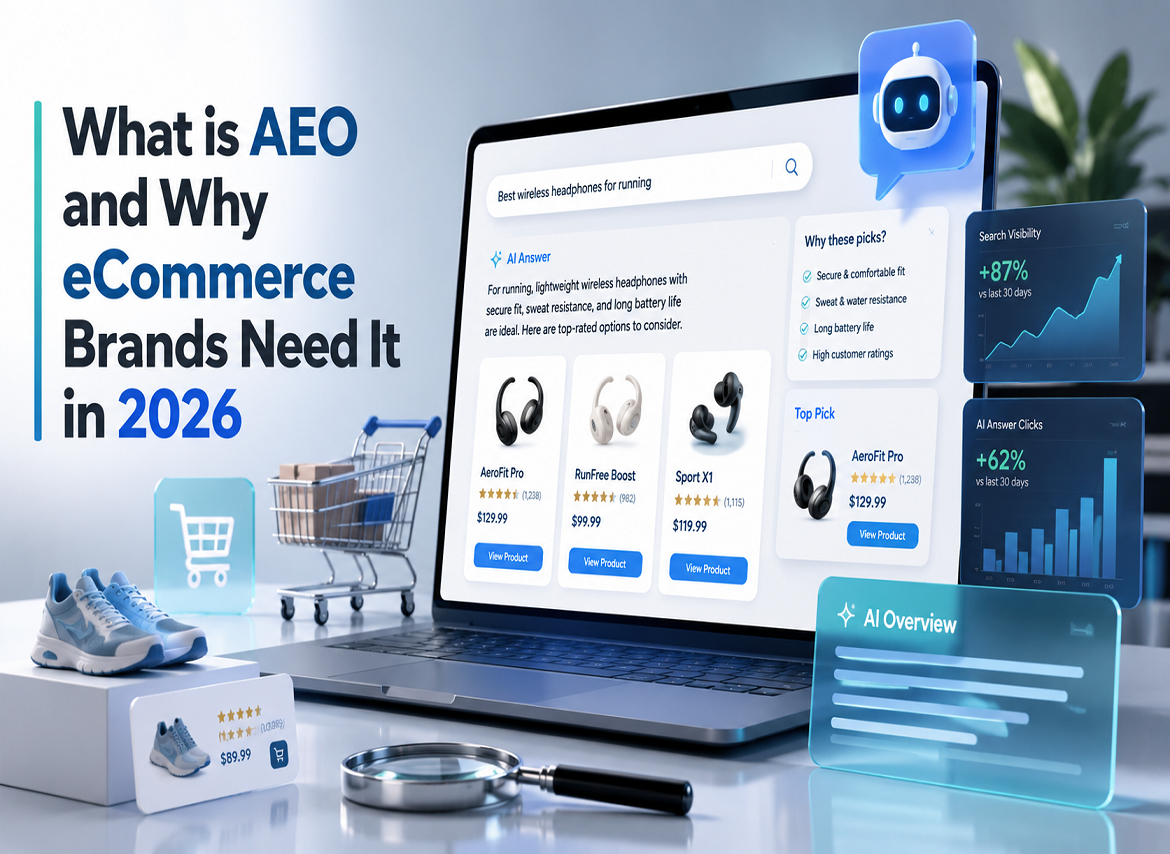

Search is evolving at a rapid pace. No longer are people entering simple keyword searches such as “best running shoes” or “cotton sarees online”. Instead, they are asking full questions to Google, ChatGPT, Gemini, Perplexity, Bing Copilot, and other voice assistants. This is where Answer Engine Optimization (AEO) comes in handy for eCommerce brands.
AEO ensures that your content is optimized enough to be understood, summarized, and recommended by the answer engines. As an eCommerce brand, Shopify store, WooCommerce site, or other online retailer, you have to know that product discovery will evolve into search results powered by AI, direct recommendations, and conversational experiences.
For any brand that wants increased organic discoverability, AEO can play a pivotal role in your eCommerce SEO services. At Cresconnect, we focus on helping eCommerce brands develop their SEO foundations with an eye on AI-powered answers and conversational search.
Google already provides details on AI features such as AI Overview and AI Mode from the standpoint of a website owner.
What is AEO?
AEO stands for Answer Engine Optimization. AEO is the optimization process of your site content that enables it to appear in direct answers, generated answers by AI, featured snippets, voice search results, and conversational searches.
SEO ranks your page. AEO is the solution that gets you on the first page because your content will actually answer the question posed by the user.
The regular SEO page may be targeting the keywords such as “best skincare products.”
However, in the case of an AEO page, the user’s queries would actually be addressed:
- Which skincare product works best for oily skin?
- Is it safe to apply niacinamide every day?
- What is the best morning skincare routine for acne-prone skin?
- Which serum can a beginner start with?
AEO in SEO: How It Differs from Traditional SEO
AEO does not take the place of SEO. Instead, AEO is an extension of SEO tailored for artificial intelligence-based searches, no-click searches, and direct answer searches.
SEO continues to be important. You continue to require fast webpages, quality content, SEO techniques, backlinking, and proper website structure. However, AEO in SEO places more emphasis on intent, entities, questions, and answers.
Factor | Traditional SEO | AEO |
Goal | Ranking pages | Getting selected as the answer |
Format | Blogs, pages, listings | Direct answers, snippets, summaries |
Focus | Keywords and backlinks | Intent, entities, structure, trust |
Best Use | Organic traffic | AI search visibility and answer placement |
Content Style | Long-form optimization | Clear answers with supporting depth |
For an eCommerce brand, this means your product pages, category pages, FAQs, buying guides, and blog content must answer customer questions clearly.
Why Answer Engine Optimisation Matters in 2026
By 2026, people will demand a fast response. People don’t want to go through ten tabs, compare data on five different blogs, and make a manual shortlist of products. They expect search engines and AI-powered assistants to help them get an overview of products and understand their pros and cons.
AI Overview refers to an artificial intelligence-based overview where Google AI gives the user an overview of key pieces of information on a topic and links to dig deeper. In addition, AI Mode helps people search deeper with follow-up questions and links on the web.
It is essential for eCommerce companies and SEO optimization if they want to show up in AI Overviews, ChatGPT, Gemini, Perplexity, etc.
Consider the following example of how answer engines work:
“How to choose the best saree fabric for summer weddings?”
An answer engine may list some suitable fabrics such as cotton silk, organza, chiffon, or linen and point out trustworthy resources. If you have a high-quality article covering the fabric type, its applications, frequently asked questions, and related products, there is a chance that it will be used as a helpful resource.
AEO can’t guarantee you’ll get featured in AI responses. However, it will improve your chances.
Why eCommerce Brands Need AEO Marketing
AEO marketing is the practice of using answer-focused content to improve product discovery, trust, and conversions.
In eCommerce, customers usually do not buy immediately. They compare, research, ask questions, check reviews, understand use cases, and look for the best option. AEO helps your brand appear during this decision-making process.
For example:
- A fashion brand can answer: “Which saree fabric is best for summer?”
- A skincare brand can answer: “What is the best skincare routine for oily skin?”
- A supplement brand can answer: “Which protein powder is good for beginners?”
- A footwear brand can answer: “Best running shoes under ₹3000”
- A Shopify app brand can answer: “How to choose the right review app for Shopify?”
These are not just informational searches. They are buying-intent searches. When your brand answers them well, you build trust before the customer even reaches the product page.
Strong content marketing for eCommerce is no longer just about publishing blogs. It is about creating answer-ready content that supports product discovery, buyer education, and purchase decisions. This is where Cresconnect helps brands turn customer questions into SEO-ready and AEO-friendly content assets.
Good AEO marketing supports:
- Product discovery
- Category page visibility
- Buyer education
- Brand authority
- Better conversion support
- Stronger topical relevance
- More qualified organic traffic
How AEO Helps eCommerce Brands Increase Visibility
AEO helps eCommerce brands become visible across different search experiences, not just traditional organic rankings.
AEO also improves product page SEO because it helps product pages answer buyer questions around features, price, material, use case, reviews, and suitability.
1. Product Discovery
The consumers might be searching for a particular problem, event, budget, material type, or application. AEO assists your products in being found when a consumer is asking a particular question.
Example:
A fashion brand can respond not only for “linen saree” but also to:
“Is linen saree good for office wear?”
2. Category Page Visibility
The key components of an effective category page should not be just a list of products, but it should also tell customers about what the category entails, its target market, proper selection, and commonly asked questions.
3. FAQ Visibility
FAQs are powerful for AEO because they match how people search. Google’s FAQ Page documentation defines FAQ pages as pages that contain questions and answers.
4. Product Rich Results
Product structured data is significant for eCommerce brands. Google explains that Product structured data helps provide rich information about your products on Search, and by combining it with Merchant Center feeds, you may increase eligibility for different product experiences.
5. Better AI Understanding
Google adds that structured data allows it to comprehend page content and the entities found on the page. This is particularly important when creating an answer engine optimization strategy because the answer engines must have clear context first.
Best Practices for Answer Engine Optimization
Here are the most important best practices for answer engine optimization for eCommerce brands in 2026.
1. Answer First, Explain After
Start important sections with a clear answer. Then add details.
Example:
Cotton sarees are good for summer because they are breathable, lightweight, and comfortable in humid weather.
After this direct answer, you can explain fabric types, occasions, styling tips, and product recommendations.
2. Use Real Customer Questions
Do not create FAQs only for SEO. Use questions from:
- Google Search Console
- Customer support chats
- WhatsApp inquiries
- Product reviews
- Sales team feedback
- Marketplace questions
- On-site search data
3. Add Schema Markup
Use relevant schema such as Product, FAQ Page, Review, BreadcrumbList, Article, and Organization. Schema.org defines Product as any offered product or service, which makes it highly relevant for eCommerce pages.
4. Build Entity-Rich Content
Mention important entities naturally. For example, a saree page can include fabric names, weaving styles, regions, occasions, blouse pairing, care instructions, and buyer use cases.
5. Improve Product Pages
Thin product descriptions will not help much in AEO. Add:
- Product benefits
- Material details
- Size or fit information
- Use cases
- Care instructions
- Shipping and return clarity
- Reviews
- FAQs
- Comparison points
6. Add Comparison Tables
Tables are useful because they make information easier to scan. You can compare fabrics, ingredients, product types, pricing plans, sizes, or features.
7. Keep Content Updated
Outdated content weakens trust. Update your product guides, FAQs, pricing details, availability, and recommendations regularly.
How to Do AEO for an eCommerce Website
If you are wondering how to do AEO for your eCommerce website, start with your customer’s questions, not just your keywords.
Before scaling AEO, brands should run a technical SEO audit to check crawlability, schema markup, page speed, indexing, and structured data errors. Cresconnect helps eCommerce brands identify these gaps so their website is easier for both search engines and answer engines to understand.
Step 1: Collect Buyer Questions
Find what customers actually ask before buying. For example:
- “Which fabric is best for daily wear?”
- “Is this product suitable for sensitive skin?”
- “How long does delivery take?”
- “Which size should I choose?”
- “Is this product beginner-friendly?”
Step 2: Map Questions to the Right Pages
Every question should have a proper place.
- Product-specific questions should go on product pages.
- Buying-guide questions should go on category pages.
- Educational questions should become blogs.
- Trust-related questions should go on FAQ or policy pages.
Step 3: Create Short Answer Blocks
Add a direct 40–60 word answer under relevant headings. This makes the content easier for answer engines to extract.
Step 4: Add Product and FAQ Schema
Use Product schema for product pages and FAQ Page schema for genuine FAQ sections. Also use Breadcrumb schema to improve page context.
Step 5: Strengthen Internal Linking
Link related blogs, category pages, product pages, and service pages together. Internal links help users move through the buying journey and help search engines understand topical relationships.
Step 6: Build Topic Clusters
For example, a skincare brand can create a cluster around “oily skin”:
- Best skincare routine for oily skin
- Ingredients to avoid for oily skin
- Best serum for oily skin
- Moisturizer guide for oily skin
- Sunscreen for oily skin
This builds topical authority.
Step 7: Add E-E-A-T Signals
Add expert inputs, updated dates, product experience, author names, reviewer details, customer reviews, and transparent policies. This builds trust for both users and search engines.
Examples of AEO for eCommerce Brands
1. Fashion Brand
A saree brand can create guides like “Which saree fabric is best for summer?” and link to cotton sarees, linen sarees, organza sarees, and cotton silk sarees.
2. Skincare Brand
A skincare brand can answer questions around ingredients, skin types, routines, and product combinations.
Example:
“Can niacinamide be used with vitamin C?”
The answer can include a simple explanation, usage tips, product suggestions, and safety notes.
3. Electronics Brand
An electronics store can compare products by battery life, warranty, features, price, and use case.
Example:
“Wireless earbuds vs neckband: which is better for workouts?”
4. Home Decor Brand
A home decor store can answer practical buyer questions.
Example:
“Which curtains make a small room look bigger?”
5. SaaS or Shopify App Brand
A Shopify app brand can create content around reviews, retention, upselling, WhatsApp automation, product recommendations, and conversion rate optimization.
Common AEO Mistakes to Avoid
Many brands try to optimize for AI search but miss the basics. Avoid these mistakes:
- Writing only for keywords
- Ignoring real customer questions
- Creating thin FAQ content
- Not using schema markup
- Publishing generic AI-written blogs
- Not linking blogs to product or category pages
- Keeping product descriptions too short
- Not updating old content
- Making claims without proof
- Missing author, brand, and trust signals
AEO works best when your content is genuinely helpful, specific, and commercially useful.
Future of AEO and eCommerce Search in 2026
There will be increased use of conversational search in eCommerce in the coming years. People will ask more complex questions, compare products using AI technology, and look for more personalized suggestions.
This requires brands to go beyond simply optimizing based on keywords. They must start considering questions, answers, entities, journeys, and trust in the equation.
AEO will be a crucial consideration for eCommerce SEO, content marketing, product page optimization, and conversion strategies. Early adopters stand to benefit from gaining credibility as trusted sources in AI-assisted searches.
Conclusion: Start Optimizing Your eCommerce Brand for AEO
One of the most significant search changes for eCommerce brands in 2026 will be AEO.
It allows for making your site more understandable for answer engines to summarize and recommend.
For Shopify websites, WooCommerce sites, D2C brands, and online stores, AEO allows improving visibility on AI searches, Google AI Overviews, voice searches, featured snippets, and conversational searches.
But you need to remember that the goal is not to fool AI algorithms. The goal is to provide more informative and relevant answers for your customers.
Begin by auditing your product pages, category pages, FAQs, blogs, schema markup, and internal links. You need to make sure that your content provides clear and concise answers to questions from buyers.
If you are unsure where to start, a professional Ecommerce SEO consultation with Cresconnect can help you identify which product pages, category pages, and blogs should be optimized for AEO first.
FAQs about AEO:
- What is AEO?
A: AEO stands for Answer Engine Optimization. It is the process of optimizing content so it can appear in direct answers, AI-generated summaries, featured snippets, voice search results, and conversational search experiences.
- What is the difference between AEO and SEO?
A: SEO focuses on ranking web pages in search results. AEO focuses on making your content clear and structured enough to be selected as an answer by search engines and AI platforms.
- Why is AEO important for eCommerce brands in 2026?
A: AEO is important because customers are using AI search tools, Google AI Overviews, ChatGPT, Gemini, Perplexity, and voice assistants to research products before buying.
- How do I do AEO for my eCommerce website?
A: Start by collecting customer questions, mapping them to the right pages, writing direct answer blocks, adding schema markup, improving internal links, and building topical content clusters.
- Is AEO marketing useful for Shopify stores?
A: Yes. Shopify stores can use AEO marketing to optimize product pages, collection pages, buying guides, FAQs, and blogs for better AI search visibility and buyer education.
- What are the best practices for answer engine optimization?
A: The best practices include direct answers, FAQ sections, schema markup, entity-rich content, product page optimization, comparison tables, strong internal links, and updated expert content.