

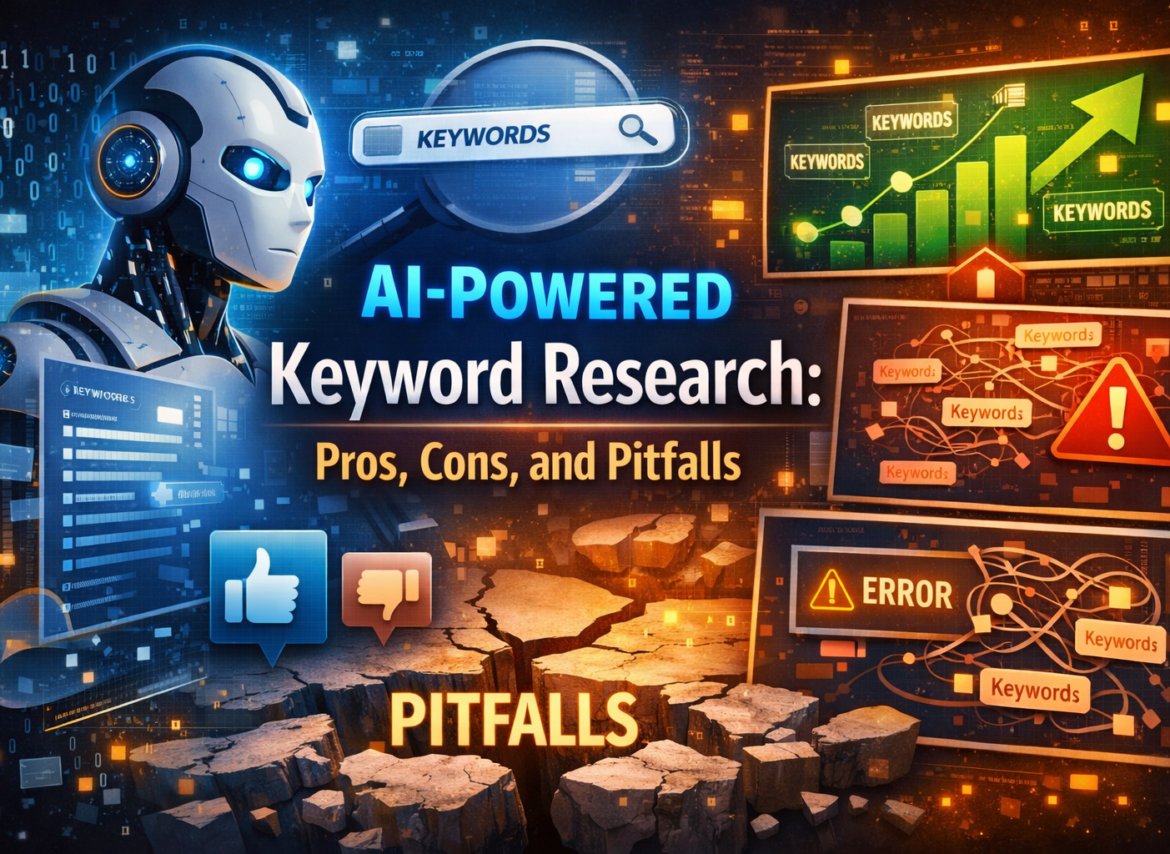

The importance of keyword research cannot be overstated; it builds the solid groundwork for a strong SEO strategy. Traditional keyword research relied on manual analysis and tools to identify the trending keywords. However, with the advancements in artificial intelligence, keyword research has become much easier than before.
AI for keyword research utilises machine learning, predictive models, and natural language processing to come up with keyword ideas. AI analyses user behaviour patterns and search trends, taking less time in comparison with traditional keyword research. In a world where time is of the essence, AI keyword research is becoming an integral part of a modern SEO strategy.
The Pros of AI Keyword Research
Speed and Scalability
One of the biggest benefits of AI for keyword research is the pace at which you can identify the right search terms. AI systems can generate a number of ideas for relevant keywords within a fraction of a second. This can be an advantage for all brands, especially if you operate across industries, locations, and products.
There are multiple AI keyword research tools available that can help analyse competitor content, identify gaps in content that you can fill, and come up with keyword suggestions that can align with the intent of your users. This speed and scalability can help AI-driven SEO go from research to execution as quickly as possible.
Better Understanding of Search Intent
Modern SEO strategy focuses on identifying the search intent behind user queries. Instead of just stuffing keywords in your content and expecting it to rank, AI models try to understand whether users are looking for more details, comparison, or buying the product. This makes it imperative to distinguish keywords based on which stage of the funnel the user is in.
AI can help separate informational, navigational, transactional, and commercial keywords. This distinction helps improve the content and reduce incorrect alignment of content and users. When intent and content match, rankings and engagement both improve.
Semantic Clustering and Topical Coverage
AI provides a significant advantage for performing keyword research by enabling semantic clustering. When using AI keyword tools, the related keywords can be grouped into meaningful clusters. This allows for a content hub and pillar content strategy, rather than lots of unrelated blog posts.
Using thematic groupings of keywords, AI-driven SEO can help your business establish topical authority rather than chasing single keywords, enabling your brand to cover entire subject matter areas and thus provide search engines with stronger contextual signals.
The Cons of AI Keyword Research
Excessive Reliance on Automation
While AI keyword research tools have the power of speed at their disposal, excessive reliance on them can pose significant risks. Generating ideas from the data will be based on the historical pattern of keywords; however, they may not have a full understanding of brand positioning, niche context, or business priorities.
Blindly relying on every AI keyword suggestion could cause you to drive irrelevant or low-conversion traffic to your website, which makes having a human oversight essential. The development of an SEO strategy should be based on both AI-driven insights and human experience & market understanding.
Data Accuracy and Context Limitations
As with many AI-powered tools, AI keyword research tools also rely heavily upon both data sources and algorithms. If the available data is outdated or incomplete, there is a good chance the suggestions will provide inaccurate results. Examples of this include search volume, competition level, & trends may not always be a direct reflection of real-time activity.
Also, in highly specialised niches where context is extremely important, AI may provide keyword suggestions that are not reflective of existing audience needs; therefore, human validation is needed to confirm that all provided keyword ideas are aligned with the actual needs of the audience.
Risk of Generic Content Planning
Many marketers can utilise the same AI keyword research tools, based on the same data, which increases the risk of content uniformity leading to duplication. This can cause the content strategies across a variety of brands to look similar, or in some cases, even identical, because many marketers use the same suggestions.
Common Pitfalls in AI-Driven SEO
Ignoring Business Goals in Keyword Research
When it comes to AI keyword research, it is important that you keep your business goals in mind. Do not go for merely high-volume keywords, but also choose low-volume ones that align with your goals. AI tools for keyword research can identify trending ideas that can drive traffic, but not always revenue.
You should ensure that your SEO strategy connects your keyword research with the business outcomes you aim for, along with aligning with your products, services, and expected brand positioning in the long term.
Chasing Volume Instead of Relevance
Most of the time, when using AI for keyword research, it prioritises metrics that can be easily measured, such as high search volume. However, it does not guarantee value. Keyword research should also focus on intent and relevance rather than just volume.
When you conduct keyword research with the help of AI, make sure you evaluate whether or not the keyword is relevant and reflects the struggles and problems of your audience, as relevance can add to credibility and authority over time.
Failing to Validate With Real Search Behaviour
SEO keyword research using AI should not be done in isolation. AI is a tool that can help you find keywords; however, you should always compare what you identify from AI tools with search console data, analytics insights, and customer feedback to ensure the keywords are relevant. User queries from real people yield valuable information about how your audience phrases their search queries.
When you combine AI keyword suggestions with actual performance data, you get better keyword research; this strategy helps you align with what your audience wants.
Conclusion: A Balanced Approach to AI Keyword Research
The use of AI for keyword research has changed the way brands develop keyword ideas and their overall SEO strategy. AI keyword research offers quick results, semantically clustered keywords, and an understanding of the intent behind keyword searches. This complements traditional keyword tools and enhances AI-driven SEO.
However, AI keyword research is not error-free. There are many reasons why over-relying on AI can be detrimental to your performance, including the limitation of data, lack of variability in your resulting content and essentially generic in nature. The key is to find a balance between AI
keyword research tools and human intelligence, how the keywords are aligned to your business and real-life validation.
When used properly, AI-driven SEO will provide you with a real competitive advantage because AI-driven keyword research does not replace the ability to think strategically but instead enhances your ability to conduct smarter, faster and targeted research, which will ultimately drive you to sustained organic growth.